


How Much Does a Cardboard Box Weigh? Complete Guide

Cardboard is the most popular packaging material today due to its flexible nature and countless benefits. It can be cut into any shape, designed in any style, and printed with excellent visuals with high-end printing techniques. With its flexible nature, cardboard makes boxes for almost all kinds of products. Popularity brings questions, and when it comes to packaging, people have a lot of them. The most common is how much a cardboard box weighs. So this blog will answer all your questions about cardboard boxes.
How Much Does a Cardboard Box Weigh?
The weight of a cardboard box depends on several factors. Although it depends on the cardboard thickness, the primary is its dimensions. How large or small a cardboard box is can help decide its weight.
The formula to calculate the weight of a cardboard box depending on its dimensions can be drawn by first multiplying the length, width, and height of the box. Once you have the figure, divide it by a coefficient that can convert the size unit into a weight unit. You can find more details on how to measure the dimensions of a box. The coefficient may vary according to the weight unit you need. Let’s discuss the different units and the formulas to calculate the weight for each unit.
Factors Affecting Box Weight
The weight of a cardboard box depends upon various factors. It’s not always the dimensions of the box that decide the weight; some other factors as mentioned below also determine the weight of cardboard packaging boxes:
- Cardboard Type: Cardstock and corrugated cardboard are two of the most common types of materials used to make cardboard boxes. Corrugated ones are heavier than simple cardstock.
- Material Thickness: The thickness of cardboard also decides the weight of your boxes. Thick durable cardboard boxes are used to pack heavy or premium products.
- Box Design: The design of your cardboard boxes also determines the weight of these boxes. Single-wall box design is lighter than double or triple-wall cardboard box designs.
- Flute Type: The internal wavy layer, such as B-flute, C-flute, or E-flute, changes the thickness and overall density of the board.
- Moisture Level: Cardboard absorbs ambient humidity from the air, which can add a small amount of water weight in damp environments.
- Wall Construction: Single-wall cardboard is the lightest. Double-wall or triple-wall boxes add extra layers of corrugated paper, significantly increasing the empty weight.
- Extra Features: Handles, wax coatings, or plastic/metal reinforcements make the box heavier.
How Much Does A Cardboard Box Weigh In Pounds?
To calculate the weight of a cardboard box in pounds, you need to divide the box dimensions by 166. The number 166 is the assumed density per cubic foot of the cardboard used to make the box. Using this formula, cardboard box weight can be calculated by:
Cardboard Box Weight = Length×Width×Height/166
Or,
CBW = L×W×H/166
Suppose if,
L×W×H=12x12x12 in then,
Weight = (12x12x12)/166
Weight = 1728/166
Weight = 10.4 Pounds
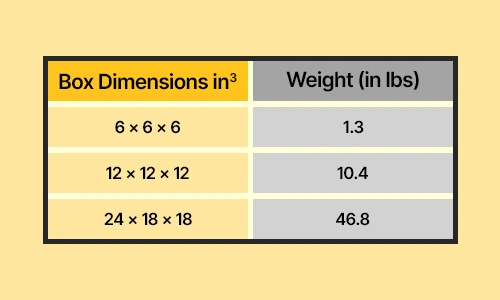
So the approximate weight of a 12x12x12 cubic-inches box would be around 10.4 pounds. Let us see the weights in pounds of variously sized cardboard packing boxes that are commonly used in the packaging industry:
How Much Does A Cardboard Box Weigh In Ounces?
The weight of a cardboard box can be converted to ounces by using the weight in pounds. Just multiply the mass value by 16 to get the weight in ounces. So for this box, you can do the following;
Weight = 10.4 Pounds × 16
Weight = 166.4 Ounces
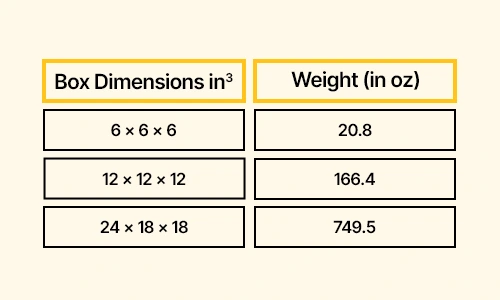
This can also help you figure out how much a small cardboard box weighs in oz. Here is a list of various cardboard boxes commonly used in the packaging industry along with their weight in oz:
How Much Does A Cardboard Box Weigh In KG?
To calculate the weight of a cardboard box in KG, we divide the volume in cm3 by 6000. The reason for dividing by 6000 is to convert from cubic centimeters to kilograms. To calculate the weight of the same box in kilograms, we first have to convert the values of the length, width, and height from inches to centimeters to get the volume in cubic centimeters.
Length, Width, Height = 12 x 2.54 cm/inch
= 30.48 cm
Now that we have the dimensions in centimeters, we can calculate the weight.
Weight = (30.48cm x 30.48cm x 30.48cm)/6000
Weight = 28316.8466 cm³ / 6000
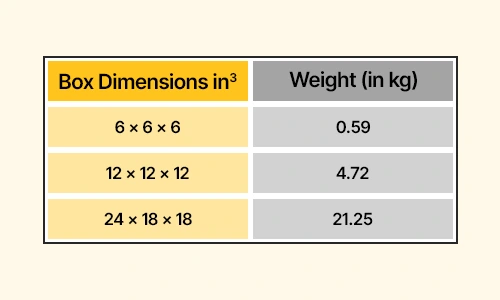
Weight = 4.7194 kilograms
Here are the weights in kilograms of differently-sized cardboard boxes:
How Much Does A Cardboard Box Weigh In Grams?
Calculating the weight of a cardboard box in grams is relatively easier. You can just convert the weight in kilograms to grams by multiplying by 1000. So the weight of the same box in grams would be;
Weight = 4.7194 x 1000
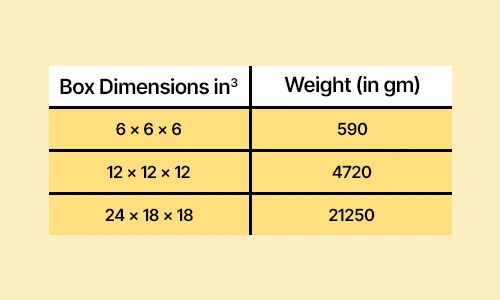
Weight = 4719.4 grams
So if you want to know how much a small cardboard box weighs in grams or even want to know the weight of a larger box, this calculation can help.
Here are the weights in grams of differently-sized cardboard boxes:
How Much Does A Large Cardboard Box Weigh?
The above formulas can be used to calculate the weight of any size of a cardboard box. Even if you want to know how much a small cardboard box weighs or the weight of a larger box, you can use these dimensions to achieve that.
However, remember that these calculations offer only an approximation of the weight of the cardboard box based on dimensions. The exact weight may also depend on the thickness of the material, along with other factors. For more details on how to customize your boxes, including printing techniques, check out our blog on How To Print On Cardboard Boxes. It is advised to use a scale to measure the exact weight of a cardboard box.
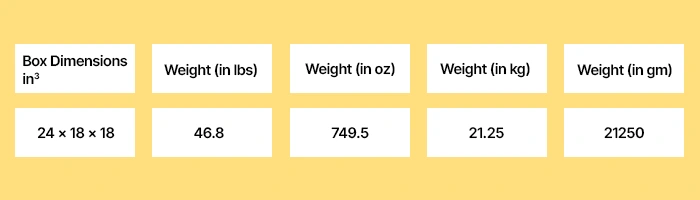
The cardboard box of volume 24 x 18 x 18 in is considered to be large in the packaging industry. Here is how much a large cardboard box weighs in different units:
How Much Does A Pallet Of Cardboard Boxes Weigh?
The weight of a pallet of cardboard boxes depends on many factors. These may include the number of boxes in a pallet, the weight of individual units, the size of the cardboard boxes, and much more. On average, a pallet of cardboard boxes has 60 boxes and weighs anywhere around 30 - 50 pounds.
The size of the cardboard boxes has a lot to do with the weight of the pallet. For example, if you have a pallet with 50 medium-sized cardboard boxes, each weighing 10 pounds, the weight of the pallet would be 500 pounds. But if you have the same number of large boxes, each weighing around 15 pounds, the weight of the pallet would be 750 pounds. So how much a cardboard box weighs can hugely affect the weight of the pallet.
Cardboard Material Weight
We’ve covered the weight of a cardboard from all aspects, but do you know how much a cardboard material weighs itself? So, here’s one of the most accurate estimates you can rely on when considering this aspect:
- For corrugated cardboard, it’s around ~0.69 g/cm³
- Non-corrugated chipboard, it’s around ~0.83 g/cm³
Note: Since it’s a moisture-sensitive material, these values may vary from one place to another and vice versa. It means that at the warehouse, the weight may be different from that at the workshop, but there won’t be a major difference unless the material is exposed to a wet environment. Learn how to make cardboard waterproof to improve its resistance to moisture.
The Difference in Weight & Strength of Cardboard
Often confused, there is no relationship between the weight and strength of the cardboard. Thick material means more sturdiness, right? But that’s not the case here! There’s a chance that the material will be thick, but it’s not powerful enough. The reason behind this is the role of the flute profile, its paper type, and the precision in its construction.
Role of Construction Behind Box Weight
When evaluating shipping logistics, how a box is designed structurally is just as important as its size. The specific way paper layers are bonded together changes the box's density, directly impacting its baseline weight and overall crushing strength. Wondering why? Look below:
The Linerboard Count
Paper is heavy. By omitting the second outer flat sheet, flat boxes shed a massive percentage of their potential raw material weight. However, standard corrugated boxes keep that second layer to create a rigid truss system, choosing maximum protection over weight savings.
The Air-to-Paper Ratio
The wavy flutes inside these boxes trap air to create a protective cushion. In flat boxes, this wave is more exposed or compressed, keeping the profile slim. Standard corrugated boxes use wider flutes that take up more physical space, requiring dense arches of paper that steadily add to the scale.
|
Box Construction Type |
Structural Design |
Weight Impact |
Performance Benefit |
|
Flat Boxes |
One fluted (wavy) layer bonded to just one flat linerboard. |
Ultra-Lightweight: Minimizes paper mass to keep postal costs as low as possible. |
Surprisingly rigid for its slim profile; perfect for books, apparel, and flat items. |
|
Standard Corrugated Boxes |
One fluted layer tightly sandwiched between two flat linerboards |
Medium to Heavy: The added linerboard increases the overall weight by roughly 1.5 to 2 times compared to a flat box. |
High stacking strength and excellent shock absorption for heavy or fragile goods. |
Ideal Weight of Cardboard Boxes for Seamless Shipping
When it comes to shipping products via cargo or shipping services, you’re charged by the weight and size of the package. Keeping the weight minimal without compromising product safety is essential for the suppliers.
You can go for boxes ranging from 0.5 pounds to 3 pounds, depending on your durability requirements. Such boxes not only reduce the shipping weight but also keep your products safe without a hassle. You can also communicate with your shipping partners to discuss the box weight requirements.
Importance of Size and Thickness
When sizing up your packaging, a box's physical dimensions and board thickness serve as key structural forces. They directly control the box's final weight. While material type sets the baseline, how much of that material you use determines how heavy your package will be before you even put a product inside.
How Dimensions Drive Box Mass
Every extra inch of box size multiplies the total surface area of cardboard required to build it. As shown in the comparison below, doubling the size of a cube dramatically escalates its physical mass:
|
Box Size (Inches) |
Average Weight Range |
Why the Weight Changes |
|
6″ × 6″ × 6″ |
120 – 150 grams |
Compact surface area; uses minimal raw material. |
|
12″ × 12″ × 12″ |
200 – 250 grams |
Increased surface area doubles the deadweight of the box. |
|
18″ × 18″ × 18″ |
300 – 350 grams |
Stepping up to medium bulk requires more paper fibers to span the distance. |
|
24″ × 24″ × 24″ |
400 – 450 grams |
Massive surface area makes this box nearly 4 times heavier than the 6-inch version. |
Material vs. Thickness
The weights listed above serve as a baseline. But the actual weight will always vary depending on how the box is designed:
Takeaway for You: You can find the sweet spot between a box that is just large and thick enough to protect your goods without adding unnecessary deadweight. It is the key to keeping your shipping costs low.
- Thickness Factor: A standard single-wall box uses one wavy layer (fluting) between two flat sheets. If you upgrade to a double-wall or triple-wall box to carry heavier items, you are stacking extra layers of paper.
- Weight Impact: Upgrading thickness can easily double or triple the base weight of the sizes shown in the chart. Even a small box can become surprisingly heavy if it uses dense, heavy-duty industrial cardboard.
Conclusion
Choosing boxes with the right weight ensures they protect your stuff without being too difficult to manage. Whether you're doing the move yourself or hiring professionals, knowing the weight of your cardboard boxes is important for a successful and smooth move.
This blog explains everything you need to know about calculating the weight of a cardboard box. Cardboard is an amazing material and is the perfect choice for packaging boxes. If you have any other questions regarding cardboard boxes, you can reach out. Keep visiting OXO Packaging for custom packaging boxes, packaging-related news, and information.
The weight of 12x12x12 boxes depends on the thickness of the cardboard and the quality of the material used. However, cardboard boxes with such measurements typically weigh between 2 to 3 pounds. This box neither burdens cargo nor makes products vulnerable to damage.
The ideal process of measuring the weight of your cardboard boxes is by weighing them on a machine. However, if you want to calculate the weight of your boxes with dimensions, you can multiply the length, width, and height of the box and divide the result by 166.
A small packaging box typically weighs between half to one pound. However, this figure may vary if the thickness and quality of cardboard used to make boxes are changed.
You can partner with a reliable packaging company like OXO Packaging to create boxes in dimensions of your preference. Share your specific weight requirements with us, and we will make sure that the weight of your boxes doesn’t exceed that limit.
The average cardboard box weighs between 0.2 to 1.5 pounds (90–700 grams) depending on its size, thickness (single, double, or triple wall), and flute type. A small mailer box may weigh 200g, while a large moving box can exceed 1kg.







 Let's Call