


Face Cards in a Deck – Everything You Should Know About Them
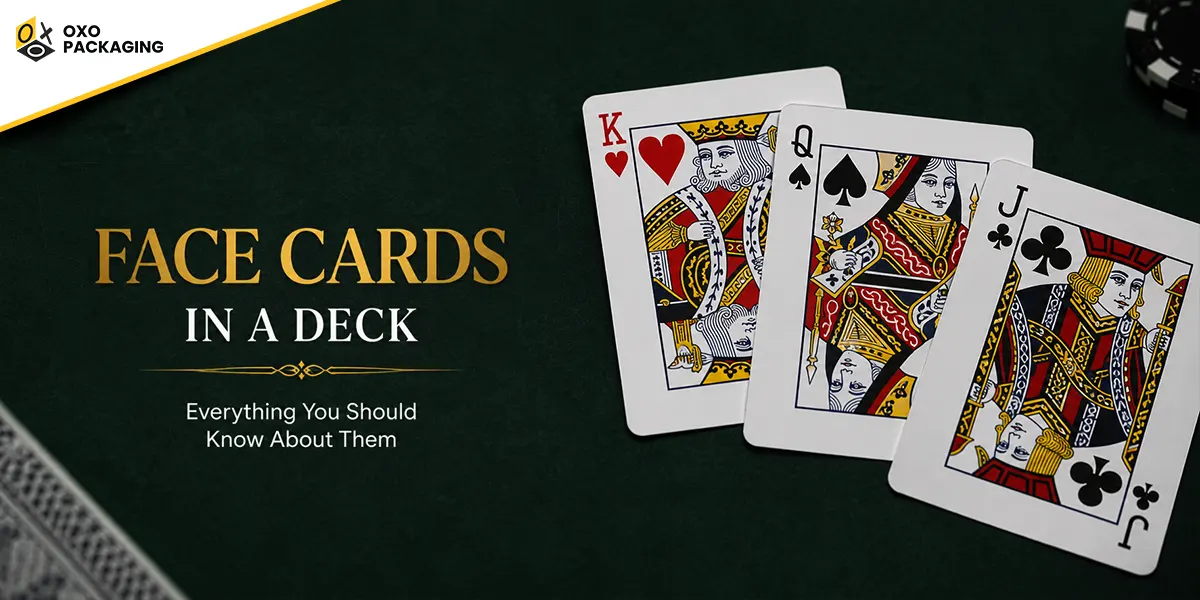
The deck of cards is incomplete without face cards. While they’re the focal point of every card game, contributing the most in point tables, while empowering the holder with significant value. Here in this guide, we’ll explore the face cards in detail and learn about their quantity, table points, and more. So, let’s read on.
What are Face Cards?
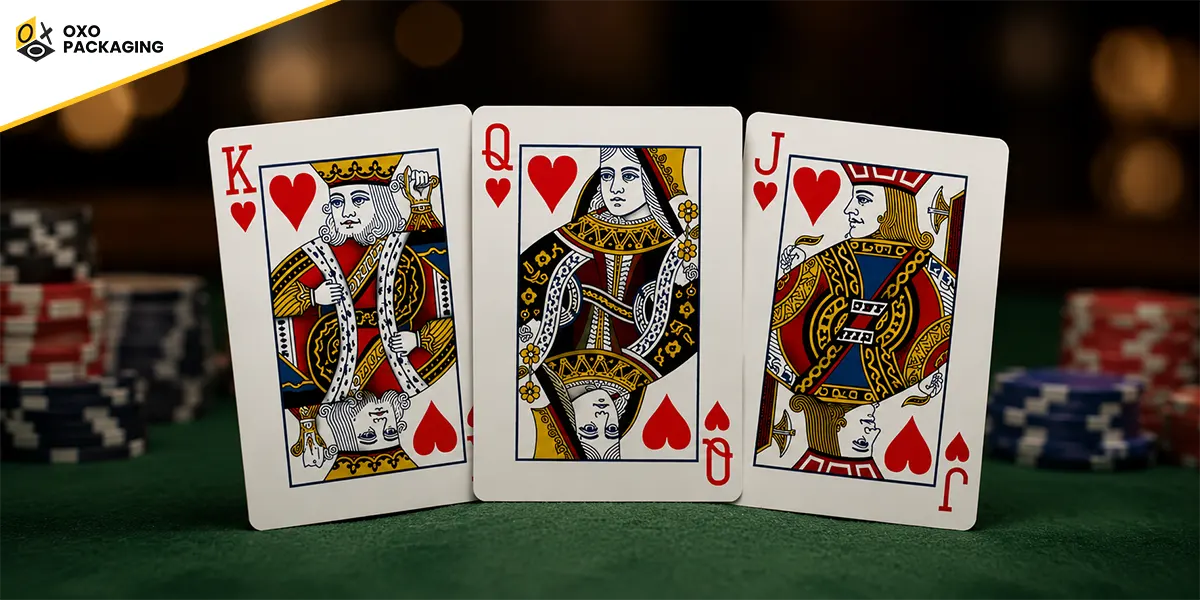
Face cards are the core of the deck, as they’re also referred to as the court cards. There are a total of 3 face cards available in the deck for each suit, including King, Queen, and Jack, or K, Q & J, respectively. Due to having the face vectors of royal figures on the playing side, they’re named as face cards. These cards are mostly packed in custom playing card boxes for protection and presentation
Why are Face Cards Called Face Cards?
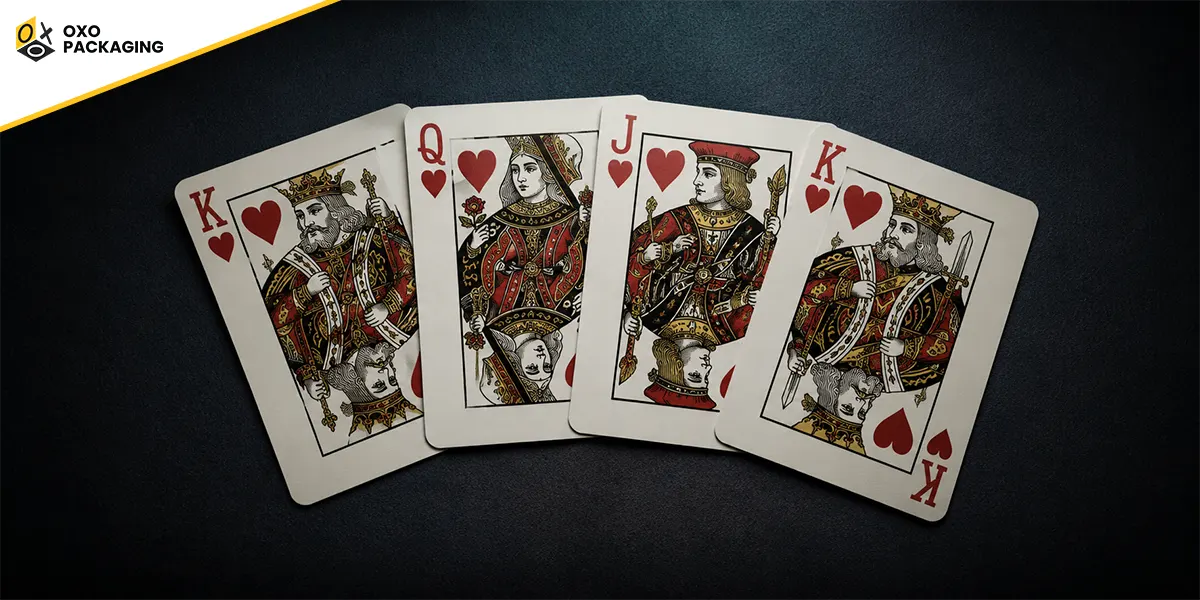
The graphical illustration on the face card was much more about the practicality of the game rather than a creative artwork. For some, this is just a painting that represents the faces of the characters. But in reality, the communication of the hierarchical authority and power.
For instance, the King holds great power and value compared to its lower-ranking subordinates, such as the Queen and Spade. That’s why they’re called the face cards, as they set them apart from the number cards, which only mention the suit with a dedicated number.
Number of Face Cards in a Deck
If you have no idea how many face cards are in a deck, no worries. The calculation is pretty simple. There are a total of 52 cards in a deck, which are divided into equal suits of clubs, spades, hearts, and diamonds. Calculating these figures, there are a total of 12 face cards in a deck of 52. While each suit has three face cards, this reflects:
|
Suit |
King |
Queen |
Jack |
|
Clubs |
1 |
1 |
1 |
|
Spades |
1 |
1 |
1 |
|
Diamonds |
1 |
1 |
1 |
|
Hearts |
1 |
1 |
1 |
Face Card Vs. Number Cards
Below is the basic difference between face cards and number cards in different aspects:
|
Features |
Face Cards |
Number Cards |
|
Definition |
Cards featuring a royal portrait |
Cards featuring numerical values |
|
Cards Included |
King, Queen, and Jack |
2 through 10 (and Ace in some games) |
|
Total per Suit |
3 cards |
9 cards (or 10 if Ace is low). |
|
Total per Deck |
12 cards |
36 cards (or 40 if Aces are numbered) |
|
Standard Value |
Usually worth 10 points |
Worth their face value (2-10). |
|
Visual Design |
Illustrations of human figures |
Repeating pips matching the card number |
Historical Perspective of Face Cards in a Deck
So far, we know that playing cards have been played for a long time, including some claims of 1000 years ago. The game then traveled to the European continent around the 15th century and then to other regions of the world. But that’s not just about the exposure of the cards to the new regions, but it also gets modified as per the territorial dynamics.
The French Standardization
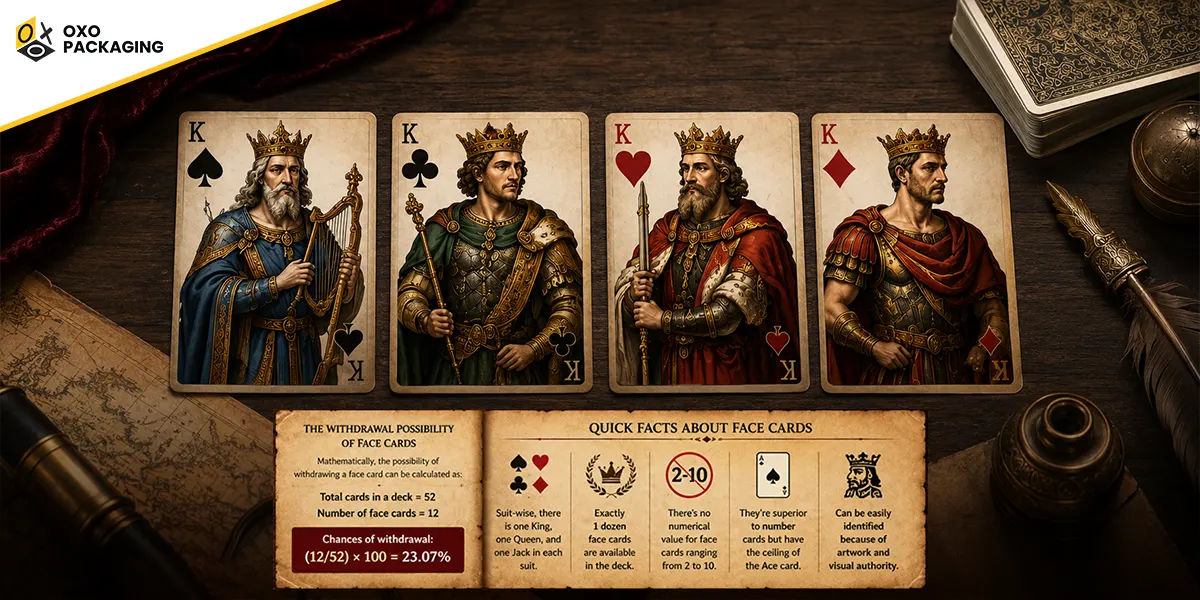
As in the 16th century when the game was introduced in France, its royal figures were assigned as we know them to-date. Below are those characters along with their symbolic elements:
- King of Spades: King David
- King of Clubs: Alexander the Great
- King of Hearts: Charlemagne (often called the "Suicide King")
- King of Diamonds: Julius Caesar
The Withdrawal Possibility of Face Cards
Mathematically, the possibility of withdrawing a face card can be calculated as:
- Total cards in a deck = 52
- Number of face cards = 12
- Chances of withdrawal: (12/52) * 100 ? 23.07%
Quick Facts About Face Cards
Even if you have read the explanation of the face cards mentioned above, you can still get an idea about it at a glance by reviewing the facts below:
- Suit-wise, there is one King, one Queen, and one Jack present in each color category.
- Exactly 1 dozen face cards are available in the deck.
- There’s no numerical value for face cards ranging from 2 to 10.
- They’re superior to number cards but have the ceiling of the Ace card.
- Can be easily identified because of the artwork, as the visuals distinguish the card’s authority more quickly.
The Bottom Line
All in all, we hope you understand a great chunk of information about the face cards. Next time you play the cards, you will have a better idea about their origin and ranks. Also, if your brand offers these cards, you can order custom playing cards from OXO Packaging. We craft the cards with high-quality materials, ensuring they remain sturdy and offer long-term playing without getting early wear and tear.
The calculation of non-face cards is simple, as there are a total of 52 cards in a deck. If we subtract the 12 face cards from it, the rest will be the 40 cards left behind.
The usual playing order of face cards is King (K), Queen (Q), and then Jack (J). There may be some expectations depending upon the game.
Not at all. An ACE card is a numeric card that either contains the highest value or sometimes a lower value, depending on the game.
The material of the face cards is similar to the rest of the options, as they’re developed in a single deck. For instance, this can be plastic-coated paper or even 100% durable plastic that is used to develop a sturdy yet flexible card.







 Let's Call