


Cereal Mascots: The Complete List of Breakfast Cereal Characters
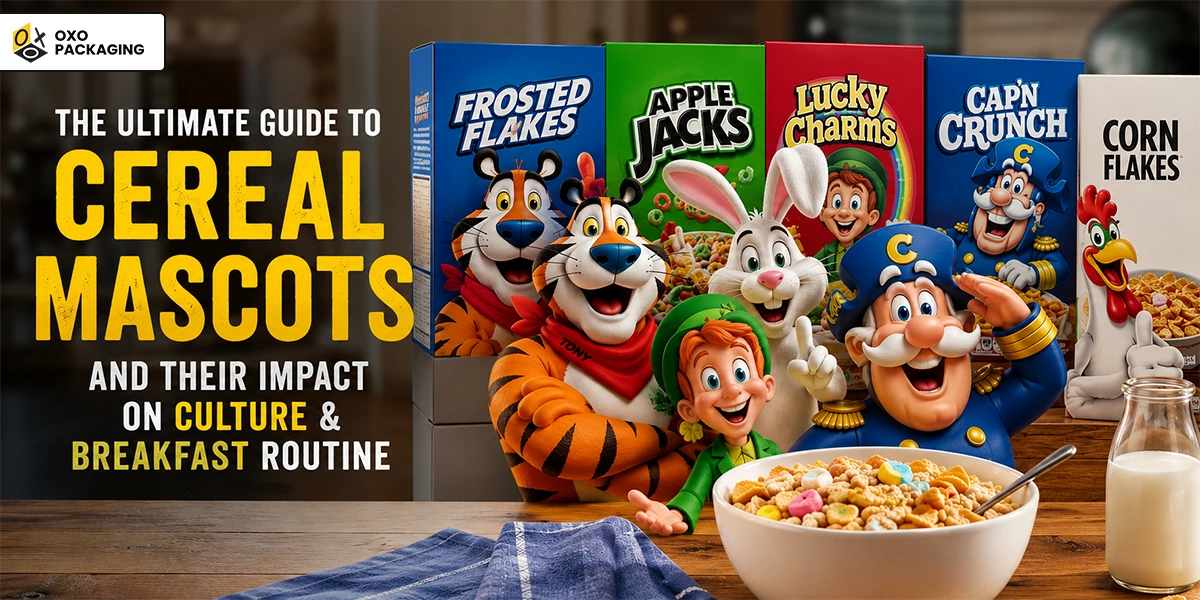
Who is the tiger on Frosted Flakes? What is the name of the Trix rabbit? Which cereal has a frog mascot? From Tony the Tiger and Toucan Sam to Lucky the Leprechaun and Snap, Crackle & Pop, cereal mascots have become some of the most recognizable characters in food advertising.
A tiger who has been selling the same cereal since 1952. Three gnomes who predate almost every other advertising character are still working today. A rabbit who has spent six decades being told he cannot have any.
Cereal mascots are more than cartoon characters on a cereal box. They help brands build recognition, communicate a product's personality, and create memories that can last for generations. This complete list of breakfast cereal mascots covers their names, cereals, companies, debut dates, famous slogans, history, and lasting influence on cereal packaging and advertising.
The Complete List of Cereal Mascots
Here is every major breakfast cereal mascot in one place, with the brand and company behind each one.
|
Mascot |
Cereal |
Company |
Debut |
|
Snap, Crackle & Pop |
Rice Krispies |
Kellogg's |
1933 |
|
Tony the Tiger |
Frosted Flakes |
Kellogg's |
1952 |
|
Cornelius "Corny" Rooster |
Corn Flakes |
Kellogg's |
1957 |
|
The Trix Rabbit |
Trix |
General Mills |
1959 |
|
Sonny the Cuckoo Bird |
Cocoa Puffs |
General Mills |
1962 |
|
Toucan Sam |
Froot Loops |
Kellogg's |
1963 |
|
Cap'n Crunch |
Cap'n Crunch |
Quaker Oats |
1963 |
|
Sugar Bear |
Golden Crisp |
Post |
1963 |
|
Lucky the Leprechaun |
Lucky Charms |
General Mills |
1964 |
|
Count Chocula |
Count Chocula |
General Mills |
1971 |
|
Franken Berry |
Franken Berry |
General Mills |
1971 |
|
The Flintstones (Fred & Barney) |
Fruity & Cocoa Pebbles |
Post |
1971 |
|
Dig 'Em Frog |
Honey Smacks |
Kellogg's |
1972 |
|
Boo Berry |
Boo Berry |
General Mills |
1973 |
|
Fruit Brute |
Fruit Brute |
General Mills |
1974 |
|
Buzz the Bee |
Honey Nut Cheerios |
General Mills |
1979 |
|
Yummy Mummy |
Fruity Yummy Mummy |
General Mills |
1988 |
|
Chip the Wolf |
Cookie Crisp |
General Mills |
1997 |
|
Coco the Monkey |
Coco Pops |
Kellogg's |
1980s (international) |
|
The Quaker Man |
Quaker Oats |
Quaker Oats |
1877 |
The Quaker Man is the outlier and worth noting: he arrived in 1877, decades before advertising mascots were a category at all, and he is one of the earliest registered trademarks in American breakfast food. Everything else on this list came after the Second World War, when television gave brands a reason to invent characters that could move and talk.
For most cereal brands, however, the mascot era expanded rapidly during the television advertising boom of the mid-20th century. Characters gave cereal companies a recognizable face that could appear consistently on television commercials, cereal packaging, point-of-sale displays, and promotional materials.
Cereal Mascot Names: Who Is Behind Each Face?
A surprising number of these characters are known by their face and not their name. Most people can picture the Corn Flakes rooster; far fewer know he is called Cornelius. Here are the names that tend to get lost:
- Cornelius — the Corn Flakes rooster, usually shortened to Corny.
- Sonny — the Cocoa Puffs bird, the one who goes cuckoo.
- Dig 'Em — the frog cereal mascot, found on Honey Smacks. If you have ever searched for the cereal with the frog on the box, this is him.
- Chip — the Cookie Crisp wolf, who replaced two earlier mascots.
- Buzz — the Honey Nut Cheerios bee, sometimes written BuzzBee.
- Sugar Bear — the cereal with the bear on the box is Golden Crisp, formerly Sugar Crisp.
- The Trix Rabbit — officially just that. Some Kellogg's-era materials called him Tricks, but General Mills has never given him a formal first name.
These cereal mascot names often connect directly to the product, character design, or personality. That makes them easier to remember and gives the cereal brand another layer of recognition beyond its name and packaging.
The Most Famous Cereal Mascots
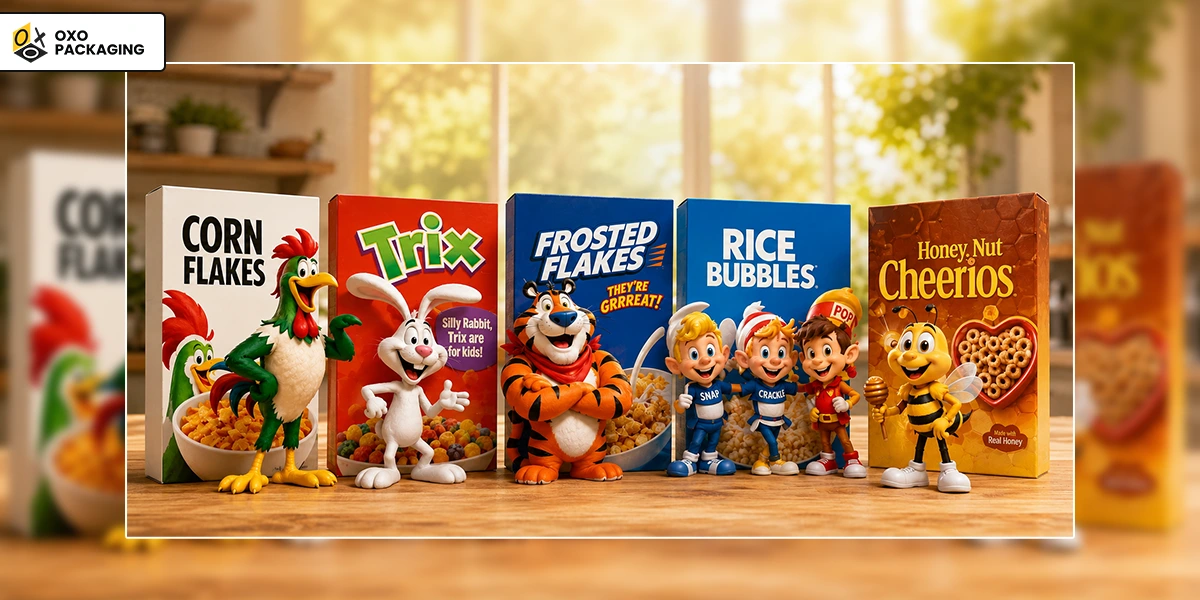
Tony the Tiger (Frosted Flakes, 1952)
Tony almost did not get the job. When Kellogg's launched Sugar Frosted Flakes in 1952, four mascots were tested against each other: Tony the Tiger, Katy the Kangaroo, Elmo the Elephant and Newt the Gnu. Tony won the test and the other three were quietly retired within a year.
What kept him going was the voice. Thurl Ravenscroft delivered "They're Grrreat!" for roughly five decades the same bass voice that sang "You're a Mean One, Mr. Grinch" in the 1966 television special. Tony also aged on screen in a way most mascots do not: he started as a four-legged cartoon tiger and became an upright, athletic, coaching figure as the brand shifted from sugar to sport in the 1990s.
Snap, Crackle & Pop (Rice Krispies, 1933)
The oldest characters on this list, and they began as one. Snap appeared alone on Rice Krispies packaging in 1933, wearing a baker's hat; Crackle and Pop were added shortly after so the three onomatopoeias the cereal actually makes each had a face.
There was briefly a fourth. Pow, a gnome associated with the cereal's nutritional "power," appeared in a small number of ads in the 1950s and disappeared. He is the answer to one of the more common cereal trivia questions, and he almost never gets a mention on other lists.
Snap, Crackle & Pop demonstrate the power of turning a product feature into a character concept. Their names directly imitate the sounds associated with Rice Krispies, making the mascot and cereal memorable as a pair.
The Trix Rabbit (Trix, 1959)
The most unusual mascot relationship in the category: a character whose entire job is to want the product and never get it. "Silly rabbit, Trix are for kids" has run, with variations, since the early 1960s.
General Mills has twice put the premise to a public vote. In 1976 and again in 1980, kids were invited to decide whether the rabbit should finally be allowed a bowl. Both times they voted yes, both times he got one, and both times the status quo returned in the next commercial. It remains one of the earliest examples of a brand running an interactive campaign built entirely around a mascot.
The Trix Rabbit is a strong example of a mascot becoming part of the brand's storytelling. Instead of simply presenting the cereal, the character creates an ongoing conflict that audiences can immediately understand.
Toucan Sam (Froot Loops, 1963)
Voiced originally by Mel Blanc the voice behind Bugs Bunny and most of the Looney Tunes cast toucan sam spoke in rhyme for his first decade before switching to the plummy British accent most people remember. His beak carries the three colours of the original Froot Loops, which is the sort of design decision that looks obvious in hindsight and was not.
Lucky the Leprechaun (Lucky Charms, 1964)
The Lucky Charms cereal mascot is the character most tied to the product's structure rather than its taste. The marshmallow shapes changed constantly hearts, stars, horseshoes, clovers, blue moons, and a long list of retired ones and Lucky's role was to narrate the changes. When a shape was added or dropped, he was the one who announced it, which gave a static cereal a reason to be news several times a decade.
Cornelius the Rooster (Corn Flakes, 1957)
The rooster cereal mascot the bird most people picture without being able to name was created by the Leo Burnett agency, the same shop behind Tony the Tiger. Cornelius is the quietest famous mascot on the list. He does not talk in most executions and he has almost no personality which is deliberate. Corn Flakes positions itself as the plain, adult, uncomplicated cereal, and a loud mascot would work against that.
Cornelius shows that a cereal mascot does not always need a loud personality. A simple, recognizable visual can support a brand when it matches the product's positioning.
The Monster Cereals (1971–1988)
General Mills built an entire sub-category out of Halloween. Count Chocula and Franken Berry arrived together in 1971, Boo Berry in 1973, Fruit Brute in 1974 and Fruity Yummy Mummy in 1988. All five were eventually pulled from year-round shelves and returned as a seasonal autumn range, which is now one of the most reliable nostalgia plays in American grocery.
Franken Berry also produced the strangest footnote in cereal history. Shortly after launch, doctors reported cases of children whose stool had turned bright pink after eating large amounts of it the dye passed through undigested. The condition was written up in medical literature in 1972 and is still occasionally referred to by the name it was given then: "Frankenberry stool." The formula was changed. The story outlived the reformulation.
The Monster Cereals became especially important to cereal nostalgia because their characters combine recognizable cereal branding with seasonal Halloween imagery. Their limited or seasonal availability also helped turn the characters and packaging into collectible nostalgia items.
90s Cereal Mascots: The Nostalgia Era
The 1990s were the last decade in which a new cereal mascot could reliably become famous, and the characters from that window are the ones driving most cereal nostalgia today.
Cookie Crisp is the clearest example of how volatile that period was. The brand went through three mascots in twenty years: Cookie Jarvis, a wizard, from 1977; the Cookie Crook and Officer Crumb through the 1980s; and finally Chip the Wolf in 1997, who has held the job since. Three complete character replacements in one brand is unusual and tells you how hard the category was competing for children's attention at the time.
The 90s also saw heavy use of licensed characters rather than original ones cartoon and film tie-ins that appeared for a season and vanished. Those did not stick, and the contrast is instructive: the mascots still working today are all owned characters that a brand could invest in for decades. Rented attention did not compound.
What the 90s did leave behind is the collector market. Sealed boxes from that decade change hands online, retro packaging reissues sell out, and adults who ate those cereals as children are now the target demographic for limited-edition throwback runs.
Female Cereal Mascots: Where Are They?
Look back at the list and one thing stands out: it is almost entirely male. Tony, Sonny, Cornelius, Sam, Lucky, Cap'n Crunch, Dig 'Em, Buzz, Chip, Snap, Crackle and Pop all male characters.
The exceptions are few and mostly secondary. Pebbles Flintstone appears on Pebbles cereal alongside Fred and Barney, but the brand is named for her rather than led by her. Yummy Mummy, from the Monster Cereals line, is one of the very few female-coded lead mascots the category has produced, and she was discontinued in the early 1990s before returning as a seasonal item.
The imbalance is a product of when these characters were created. Mid-century advertising defaulted to male protagonists and female supporting roles, and because cereal mascots are unusually long-lived, the category never got the natural refresh that would have corrected it. A mascot invented in 1963 is still on the box in 2026, which means the assumptions of 1963 are still on the box too.
For anyone designing a mascot now, that is an open lane rather than a problem. The category has very little female-led character equity, and almost no modern brand has tried to claim it.
Cereal Mascot Costumes
Cereal mascots have a second life outside the box, and it is bigger than most people assume.
Tony the Tiger, Toucan Sam and the Monster Cereals characters are consistently popular Halloween costumes, partly because they are instantly recognisable and partly because the silhouettes are simple a striped tail, a large beak, a top hat and cape. Group costumes work especially well here: Snap, Crackle and Pop is one of the few three-person costumes where everyone gets an equal role.
Brands run their own versions too. Licensed mascot suits appear at sponsored sports events, in-store activations and grocery promotions, and the character walking a supermarket aisle is often a child's first physical encounter with a brand they have only seen printed. It is an old tactic and it still works, because it converts a flat image into something a child has actually stood next to.
Cereal Slogans: The Lines That Outlived the Ads
A mascot without a line is just a drawing. The catchphrase is what actually survives, and in most cases people remember the slogan more precisely than the character who says it.
|
Slogan |
Mascot |
Cereal |
|
"They're Grrreat!" |
Tony the Tiger |
Frosted Flakes |
|
"Silly rabbit, Trix are for kids!" |
The Trix Rabbit |
Trix |
|
"Snap! Crackle! Pop!" |
Snap, Crackle & Pop |
Rice Krispies |
|
"Follow my nose! It always knows!" |
Toucan Sam |
Froot Loops |
|
"They're magically delicious!" |
Lucky the Leprechaun |
Lucky Charms |
|
"I'm cuckoo for Cocoa Puffs!" |
Sonny the Cuckoo Bird |
Cocoa Puffs |
|
"Can't get enough of that Golden Crisp!" |
Sugar Bear |
Golden Crisp |
|
"Dig 'em!" |
Dig 'Em Frog |
Honey Smacks |
|
"Yabba dabba doo!" |
Fred Flintstone |
Fruity Pebbles |
Two patterns are worth noticing. The best cereal slogans are short enough for a child to repeat without being taught three or four words, heavy on sound. And several of them describe the eater rather than the food: "I'm cuckoo for Cocoa Puffs" is a statement about you, not about the cereal, which is a far stickier thing to say out loud.
Which Cereals Do Not Have a Mascot on the Box?
The question comes up more than you would expect, and the answer is a clean split down the middle of the aisle.
Cereals aimed at adults generally carry no character at all. Plain Cheerios, Special K, Corn Chex, Grape-Nuts, Shredded Wheat, Total and most granola and bran products use photography of the product, a bowl, or a health claim no mascot, no cartoon, no eyes.
That is not an oversight. A mascot signals "this is fun and it is for children," which is precisely the wrong message for a cereal selling fibre, protein or weight management. Where adult cereals do use a face, it is usually a real person or a founder figure rather than an invented character the Quaker Man being the oldest example of that approach.
The rule is reliable enough to use as a shelf test: if a cereal box has a cartoon animal on it, it is being sold to a five-year-old. If it has a photograph of the cereal in milk, it is being sold to that five-year-old's parent.
Why Cereal Mascots Work
Three things explain why this particular category produced characters that outlast most companies.
The box is the advertisement. Cereal is eaten slowly, from a container that sits on a table facing whoever is eating. No other grocery product gets that much uninterrupted attention from its buyer. A mascot on a soup can has a few seconds on a shelf; a mascot on a cereal box has twenty minutes a morning for a week.
The audience renews itself. A child ages out of the target demographic in a few years and is replaced by another. A mascot that works does not need to evolve much, because the audience it is speaking to is permanently five years old. That is why Tony can run for seventy years without a reinvention that would kill a mascot in any other category.
Design was built around eye level. Children's cereals sit on lower shelves, and the characters on them are drawn looking slightly downward, so a child standing in the aisle meets the mascot's gaze. Adult cereals, on higher shelves, use straight-ahead or absent characters. Once you know to look for it, you cannot walk down the aisle without seeing it.
What This Means for a Modern Brand
Most new cereal and snack brands will never build a Tony the Tiger, and they do not need to. The transferable lesson is narrower than "invent a character."
What the surviving mascots have in common is consistency and ownership. They were used continuously for decades, on every box, in the same visual position, by a company that owned them outright. The brands that rented attention licensed film characters, seasonal tie-ins have nothing left to show for it.
For a smaller brand, that translates into something achievable: a single recognisable visual device used identically on every SKU, every year. It can be a character, but it can equally be a colour block, a shape or an illustration style. What matters is that it does not change every time someone new joins the marketing team.
Putting Your Own Character on the Box
If you are designing packaging around a character, the print specification matters more than it does for a text-led box. Explore these cereal box design ideas to see how artwork, colors, typography, and interactive elements can make your packaging more distinctive and memorable.
At OXO Packaging we produce cereal boxes in food-grade kraft, paperboard and cardboard, printed CMYK or to Pantone when a character has a fixed brand colour that has to hold across runs. Free design support is included, there are no die or plate charges, and you approve a digital proof before anything goes to print. Related formats include mini cereal boxes for sampling and wholesale cereal packaging for larger runs.
If you are still working out dimensions, our guide to cereal box dimensions covers the standard retail sizes, and what cereal boxes are made of explains the board options.
Whether you are launching a new cereal, refreshing an established product, or developing seasonal packaging, your box is one of the most visible parts of your brand identity. A recognizable mascot combined with strong packaging design can help your product stand out on crowded retail shelves. Contact OXO Packaging to discuss your custom cereal box design, materials, printing, and packaging requirements.
The Quaker Man, introduced in 1877, predates every other character on this list by more than fifty years. Among the modern television-era mascots, Snap of Rice Krispies is the oldest, first appearing on packaging in 1933.
Cornelius, usually shortened to Corny. He was created by the Leo Burnett agency in 1957, the same agency behind Tony the Tiger.
Rarely, and only when the public has voted for it. General Mills ran campaigns in 1976 and 1980 asking children whether the rabbit should be allowed a bowl. Both votes went in his favour, and in both cases the rule returned in the next commercial.
Pow. He appeared in a small number of 1950s advertisements, associated with the cereal's nutritional value, and was dropped. Snap, Crackle and Pop have been a trio ever since.
Several. Katy the Kangaroo, Elmo the Elephant and Newt the Gnu were dropped in 1952 when Tony the Tiger won the Frosted Flakes launch test. Cookie Jarvis and the Cookie Crook were both replaced on Cookie Crisp before Chip the Wolf took over in 1997. Fruit Brute and Yummy Mummy left year-round shelves and now return seasonally.
"They're Grrreat!" is the most widely recognised, delivered by Tony the Tiger since 1952. "Silly rabbit, Trix are for kids" and "I'm cuckoo for Cocoa Puffs" are close behind, and all three share the same trait: short, sound-driven, and easy for a child to repeat unprompted.







 Let's Call