


The Ultimate Lipstick Box Design Guide for Beauty Brands
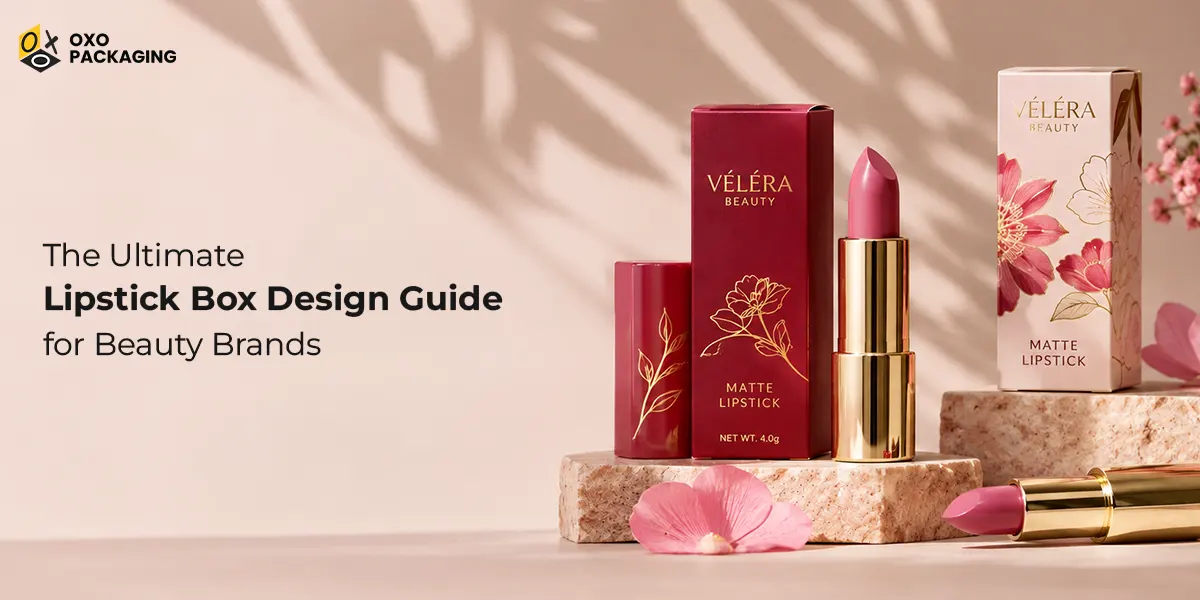
Develop loyal or die-hard customers with the quality of your products, but packaging helps your customers choose your products and experience them before they finally become loyal fans of your cosmetic brands. Packaging works best when designed carefully for the ideally chosen prospects, considering the nature and details of your brand and your target and potential customers.
Here in this guide, you will explore from designing to finally crafting your personalized lipstick box packaging for your beauty brand.
Why Does the Lipstick Box Matter More Than You Think?
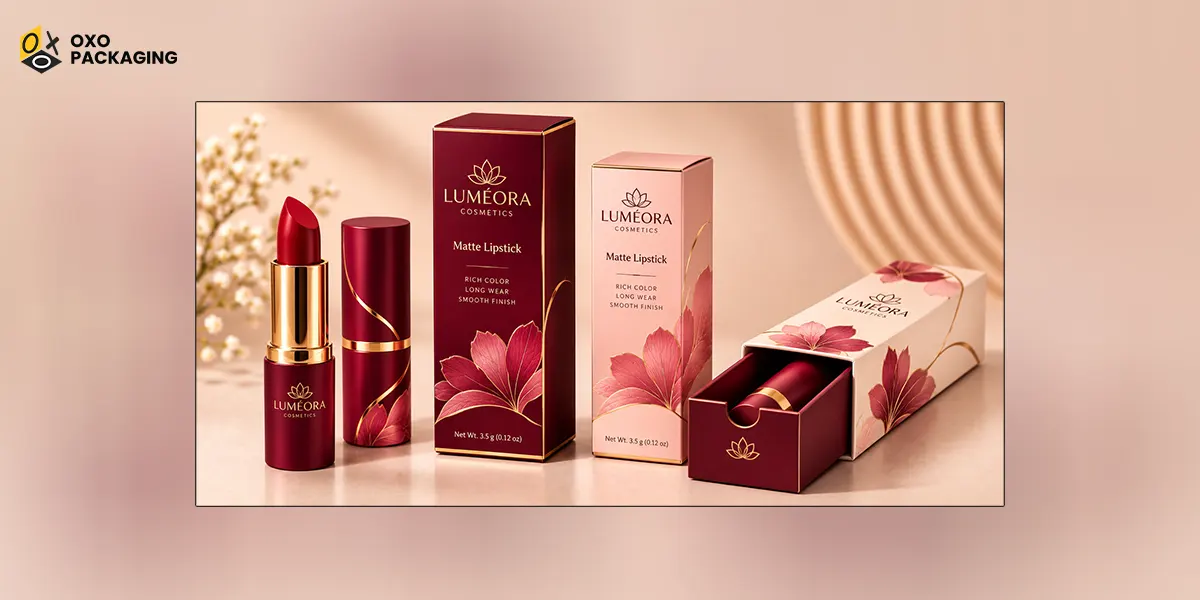
First impressions matter in grabbing prospects' attention, leading to their final decision on whether to choose your products from the busy and crowded market flooded with brands’ items. Give attention to the details of your product's outer or secondary box packaging that ultimately lose or win your customers' eyeballs, and convert to increased ROI.
Enhance your product's unboxing experience, improve the presentation without losing the most important functionality of protecting your fragile bullet from heat, drops, and friction during shipping. Now, let's explore the materials, dielines, legal rules, and finishing touches to boost your brand visibility on the retail shelves.
Exploring the Top Cosmetics Packaging Trends
Circular sustainability, digital integration, and multi-functional designs are among the top cosmetics packaging trends. You can explore what to consider while designing your quality custom lipstick boxes for your brand. The following are certain popular and trending packaging options that you need to consider for your diligently designed custom cosmetic boxes wholesale.
One of the most trending cosmetic packaging trends is eco-luxe and circular sustainability. Going beyond the concept of vague "green" claims, brands are now more efficient and use post-consumer recycled (PCR) content, mono-material designs (like all-PP or all-PE), and home-compostable or plant-based materials like mycelium.
Reusability is another trending and great choice for lipstick packaging for your brand. Refills are expanding from luxury skincare and serums into color cosmetics and hair care, reducing single-use plastic waste and ideally replacing the traditional one-time-use packaging for the products.
Embedded QR codes, Near Field Communication (NFC) chips, and Digital Product Passports (DPPs) are amazing choices and are trending also, as they link physical bottles to online routines, ingredient origins, and tutorials.
Don’t take the sensory and tactile design choice for granted; it is highly trending for beauty products, and heavy glass, brushed metal accents, soft-touch matte finishes, embossed logos, and satisfying audible closure clicks drive emotional wellness and shelf appeal.
Now, move to the next step of designing, choosing materials, structural styles, and finishing options for custom cosmetic boxes without ignoring the regulatory compliance and legal labelling requirements.
Step 1: Defining Your Brand Personality & Target Audience
With the effective use of brand personality, you can create and enhance emotional feel, give a human touch, and most often used by the top cosmetic brands. Consider the following:
-
Defining Your Brand Nature
Down-to-earth, honest, and caring, as showcased by Dove, are mostly focused on ingredient transparency, ethical sourcing, and clean formulas. Add excitement with the daring, spirited, and imaginative as claimed by Fenty Beauty, which focuses on vibrant color palettes, trend-driven drops, and bold packaging. Showcase competence through reliable, intelligent, and successful impressions, which focus on clinical efficacy, dermatologist backing, and science-led skincare data.
Be different by choosing sophistication with upscaling, refining, and charming claims as Glossier's minimalist luxury. It focuses on sleek glass containers, muted tones, and understated elegance.
Stay in the leading position in your highly competitive market by establishing a consistent tone of voice—whether playful, clinical, luxurious, or bold—on every platform: your website copy, packaging, and social captions.
-
Defining Your Target Audience
Keep in mind that you cannot market to everyone; if you try, you will produce a diluted message to your prospects and target audience. Instead, narrow down your potential customers and prospects through concrete data and detailed buyer personas. Some major areas through which you can create a more relevant and effective target audience include:
Demographics, which deal with the specific age ranges, geographic locations, household income, education levels, and gender identity. Tools like Cosmetic Index insights, Google Analytics, or social media follower breakdowns to collect real metrics might help you greatly.
Psychographics help you understand your audience's core values, lifestyle habits, hobbies, and personal beliefs (e.g., sustainable living, veganism, anti-aging dedication).
Pain Points and Goals have the real potential that can help you perfectly create the desired products, packaging, and messaging, as they identify what frustrates them about current options (e.g., makeup that cakes, lack of deep skin-tone shades, or overly complex 10-step routines), and position your product as the direct solution.
-
Creating Detailed Buyer Personas
Build 2 to 3 distinct fictional characters that will help you clearly understand, demonstrate, and direct your efforts in creating highly rewarding results for your product development, packaging, and marketing strategies. Example 1: A 35-year-old fitness gym instructor who prioritizes clean, cruelty-free ingredients and eco-friendly, recyclable packaging. Example 2: A 40-year-old working parent who needs quick, reliable, multitasking cosmetic products that fit a 5-minute morning routine.
Step 2: Choosing the Right Materials
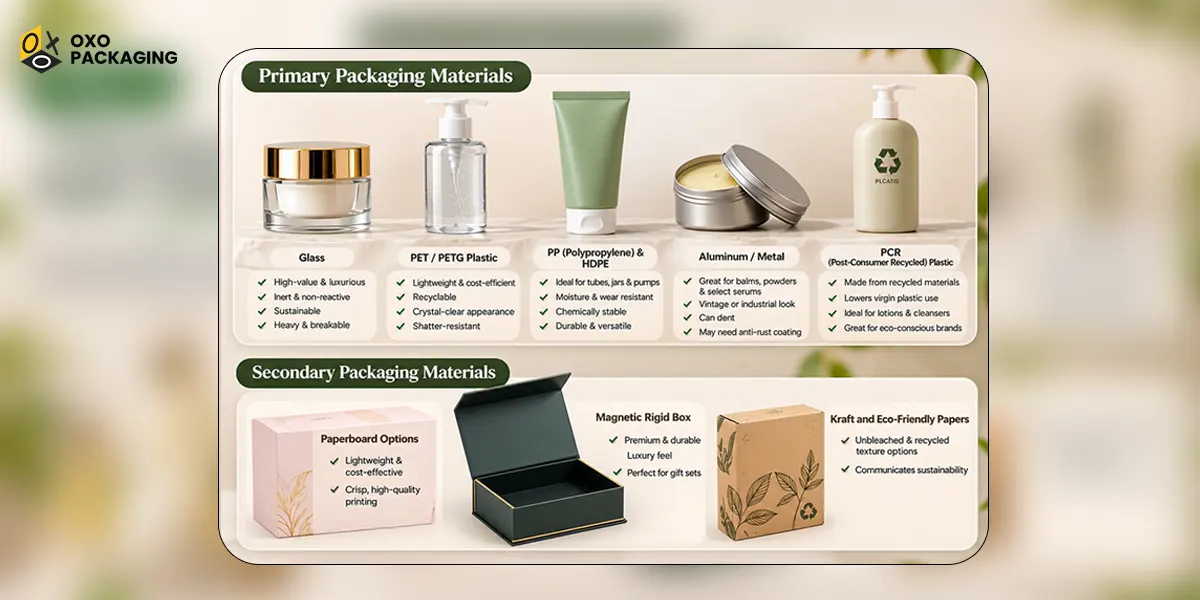
The three types of packaging- primary packaging, secondary packaging materials, their structures, and styles should be chosen diligently to effectively showcase your products and create room for your brand distinction. Let’s die in more details:
-
Primary Packaging Materials
Primary packaging materials that are directly in connection with the products or formula formation are most likely from the following popular packaging material options:
- Glass: A delicate, high-value, and sustainable material, which is best for luxury skincare, foundations, and fragrances. It is inert, biocompatible, and non-reactive with acids, but heavy and breakable.
- PET / PETG Plastic: A lightweight, cost-efficient, and recyclable material is ideal for lightweight, crystal-clear bottles and travel products. It offers shatter resistance and chemical stability.
- PP (Polypropylene) & HDPE: A great choice for squeeze tubes, cream jars, and airless pumps. They resist moisture, wear, and chemical degradation.
- Aluminum / Metal: With amazing features, an excellent choice for balms, powders, or select serums. It provides a vintage or industrial aesthetic, though it can dent and may need anti-rust or inner-lining coatings.
- PCR (Post-Consumer Recycled) Plastic: Ideally chosen for the eco-conscious mass-market or prestige lotions and cleansers to lower virgin plastic reliance.
-
Secondary Packaging Materials
Different packaging materials provide entirely different and unique functionalities and roles. The following are some popular material choices for the secondary packaging that are excellent for attracting and influencing prospects and customers in their purchase decisions.
- Paperboard Options: They are lightweight, cost-effective, and ideal for crisp graphic printing for secondary custom cosmetic boxes for the products.
- Rigid Board: A great choice for the heavy-duty, luxury-feeling boxes mostly used for gift sets or flagship lines.
- Kraft and Eco-Friendly Papers: Mostly chosen from the unbleached, recycled texture options to communicate sustainability and instantly grab the attention of the eco-conscious prospects and customers.
Step 3: Mastering Visual Design & Typography
Before you move to the crafting of your box packaging, you need to pay attention to your visual design and typography. For a distinctive presence in your product market, you need to master designing for your product packaging or choose the ideal custom packaging partner for your cleverly crafted packaging with catchy design, bold or sophisticated typography for your cosmetic brands:
-
Typography Styles and Brand Feel
From the variety of available fonts, condensed fonts with narrow letterforms fit longer text onto small containers or labels while communicating a compact, high-fashion, or utilitarian mood (e.g., Sand & Sky, Make Beauty). Standard width fonts offer balanced and versatile letterforms that work well for clear product info and everyday clarity (e.g., Rose INC, Ami Cole).
Wide or extended fonts display stretched-out letters to create openness, calm, or upscale elegance (e.g., Estrid, Topicals, Humanrace). And the Serifs or display serifs lean traditional, heritage, or high-end luxury message, while clean sans-serifs communicate a modern, clinical, or clean-beauty aesthetic look.
-
Letter Case and Psychological Impact
All Caps (Upper Case) format is used for a clean, minimal, and authoritative context, and is frequently used for luxury logos or product categories (e.g., Ilia, Fenty Skin, Naturium). Lowercase displays a soft, casual, and modern look, which offers an approachable and youth-driven feel(e.g., Nuse, Foile).
Capitalized (Title Case) offers the first letter of each word is capitalized, creating a classic, legible structure (e.g., Glossier, Kosas), is a popular choice. And last but not least, mixed case and spacing provide generous letter spacing (tracking), while all-caps typography heightens the perception of exclusivity and luxury.
-
Strategic Design Principles for Packaging
-
Legibility at Small Scales: Packaging of different types of structures, styles, and sizes requires distinctive design principles; tiny font sizes on lip balm tubes, dropper bottles, or sample sachets require high stroke contrast and clean spacing to avoid blurring into an illegible block.
-
Stroke Contrast (Monoline vs. Varied): Uniform (monoline) strokes feel contemporary and direct for the clear messaging the brand voice, whereas high-contrast thick-and-thin strokes evoke classic editorial elegance for the luxury and premium brands.
- Cohesive Visual Hierarchy: Produced with a pair of fonts, a distinct display or logo font with a highly legible secondary sans-serif for ingredient lists, usage instructions, and shade names so the package remains functional and clean.
Step 4: Special Finishes & Tactile Enhancements
Special finishes, coatings, and laminations can effectively showcase brands' message, their products' perceived value, and instantly grab the attention of prospects. The following features can help you choose the brand display and product visibility on the retail shelves, counter displays, and online stores.
You can elevate the unboxing experience of your products by choosing foil stamping with metallic gold, silver, or rose-gold accents. Embossing or debossing are other choices with their raised effect to highlight your logos or specific text for tactile depth. Spot UV coating with a high-gloss shine layered over a matte laminate background can boost the brand details. And the lamination choices, with a variety of options like matte, soft-touch velvet, or high-gloss finish, can effectively display your products.
Step 5: Navigating Regulatory Compliance & Mandatory Labeling
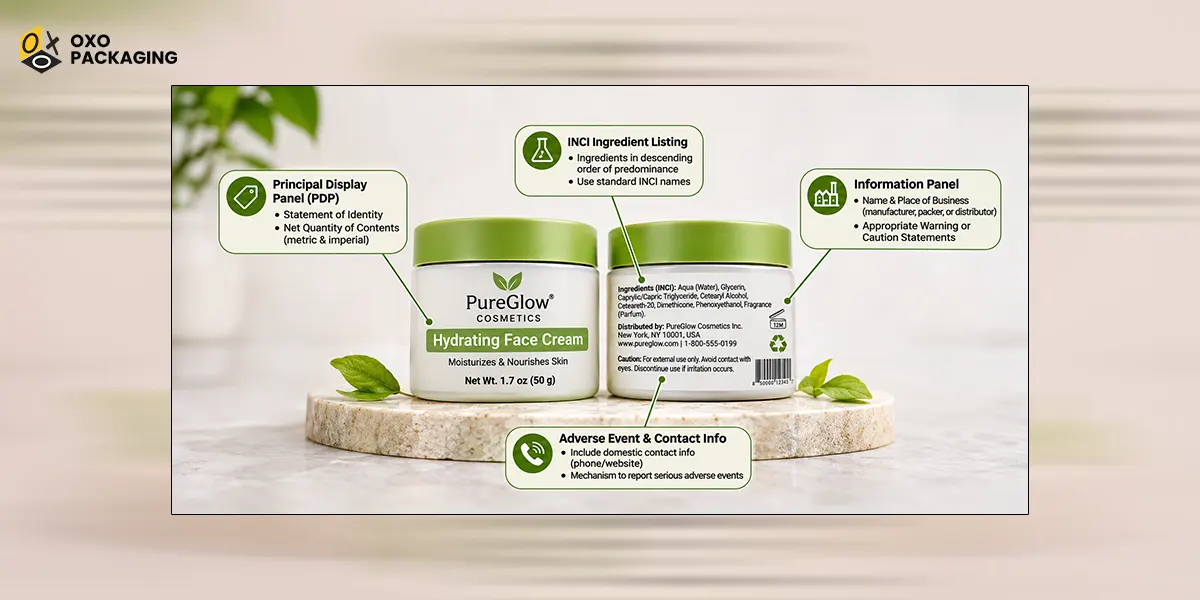
Regulatory compliance and mandatory labelling requirements are a must to showcase your brand commitment, efficient use of your resources, and win your prospects' and customers' trust and confidence.
The following are some mandatory U.S. labeling and compliance requirements (MoCRA / FDA):
Principal Display Panel (PDP) requires that the packaging must clearly show the Statement of Identity (common/usual name or descriptive function) in bold type and the Net Quantity of Contents in both metric and imperial units. Information Panel requirements state that the packaging must list the Name and Place of Business (manufacturer, packer, or distributor) and appropriate Warning or Caution Statements (e.g., for aerosols or unsubstantiated safety).
INCI Ingredient Listing demands for the ingredients that they must appear in descending order of predominance using standard International Nomenclature of Cosmetic Ingredients (INCI) names. Adverse Event & Contact Info are also a must to place on the labels, or records must include domestic contact info or an electronic/phone mechanism to report serious adverse events. Also showcase facility and product registration biennially with the FDA, and product listings must be kept current.
Step 6: Setting Up Dieline and Working with Manufacturers
Several design tools and software are available to seek help for the lipstick box design for your beauty brand. You can draft the dieline by using Adobe Illustrator to map exact panel dimensions, bleed lines, and fold/cut scores. In the prototyping phase can order structural blank samples (white dummies) to test tube fit. And run digital color test prints before mass production to avoid unwanted losses and undesirable costs.
Wrapping Up!
Balancing aesthetics, cost, and compliance can create unbelievable packaging for your beauty products. This comprehensive lipstick box design guide for beauty brands can help cosmetic businesses decide on packaging that can influence prospects to convert, stay loyal, and become their repeat buyers. For your convenience, partner with a reliable, leading, and perfect custom packaging solution provider, like OXO Packaging, and stay prominent in your competitive market.






 Let's Call