


How to Measure Tin Box Dimensions? Explore Here!
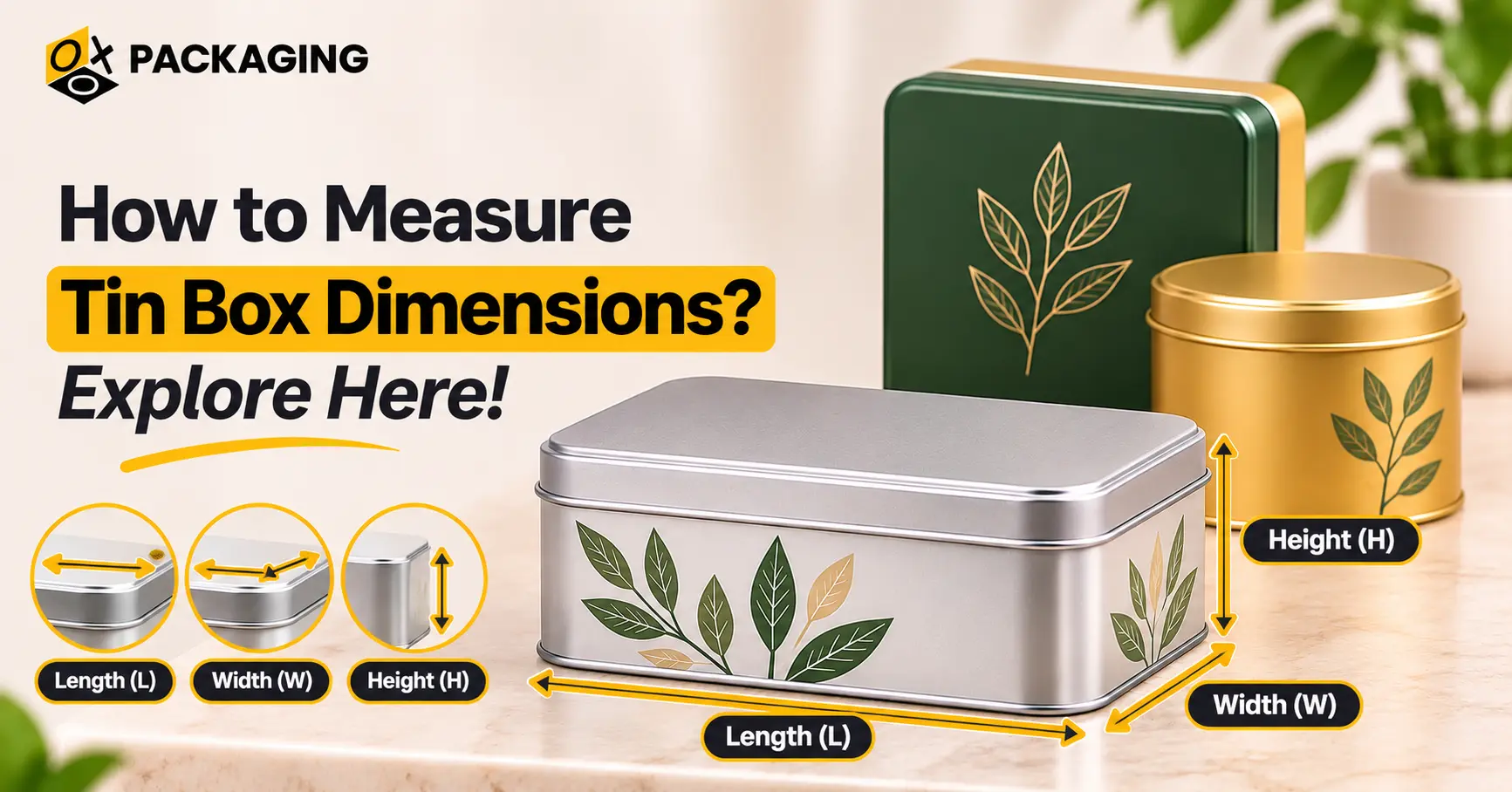
Choosing tin boxes doesn’t mean they are enough to protect your products. Though they are sturdy, the way you design them plays an important role in protecting your goods. That’s where tin packaging box dimensions come into play.
The key here is to measure tin dimensions correctly. This way, your products will fit in tin containers without rattling, jamming, or getting crushed. Read this blog to learn how to measure tin box dimensions the right way.
Three Dimensions of a Tin Box
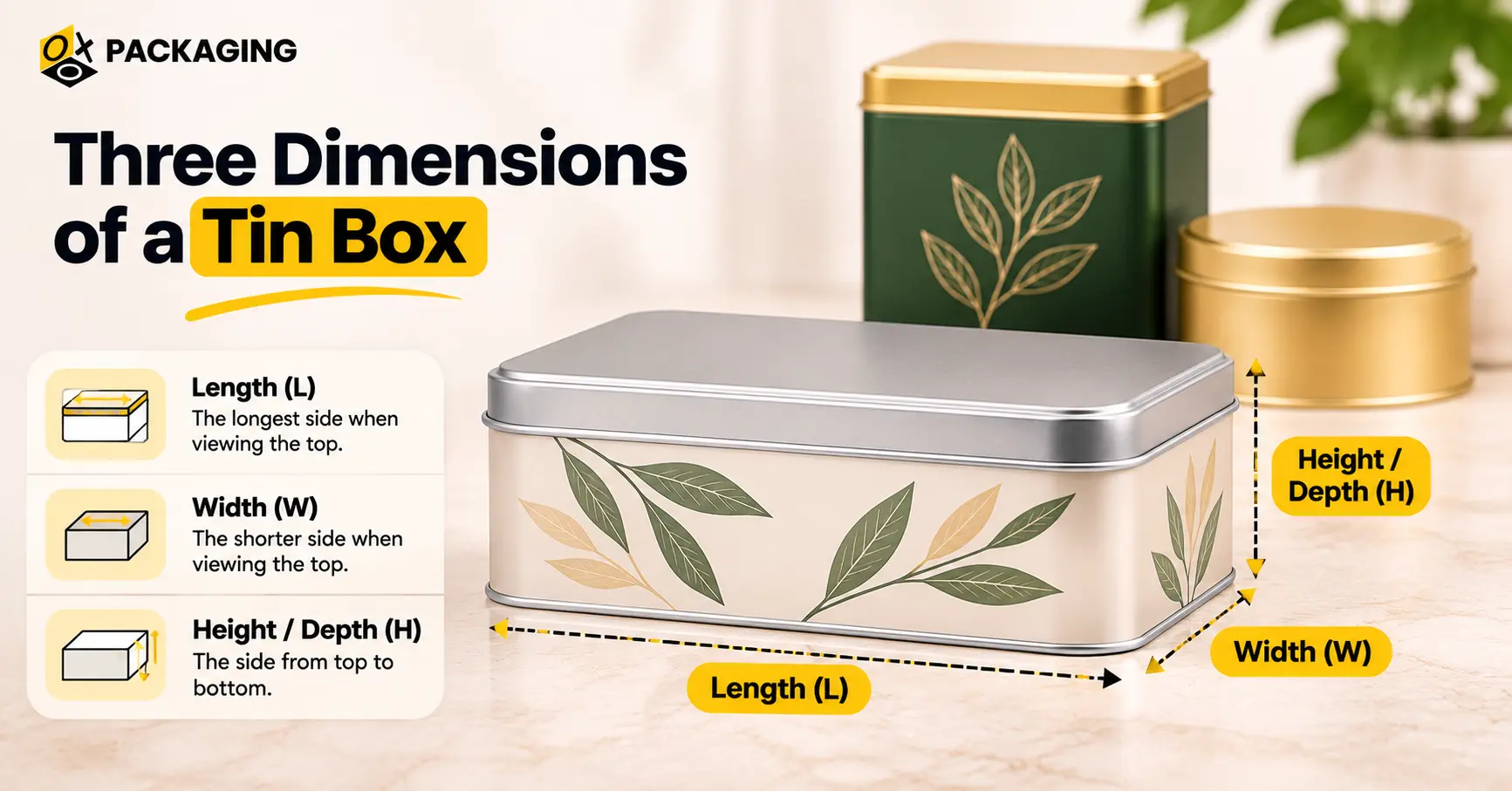
Like paper boxes, tin boxes also have three dimensions, e.g., length, width, and height (depth). To measure these dimensions, follow a standard orientation rule. Place the tin box in a vertical position with the lid facing up to measure.
Wondering what these dimensions actually are? Have a look below:
- Length: The longest side when looking at the top of the box.
- Width: The shorter side when looking at the top of the box.
- Depth(Height): The side perpendicular to the length and width.
Always Follow the Right Order: Length x Width x Height (LxWxH)
Whether you measure a custom tin packaging box, can, or jar, don’t always keep your order in the standard Length × Width × Height (L × W × H) format. It applies to all rectangular or square tins.
Conversely, if your tins are round or cylindrical, measure using the Diameter × Height (Ø × H) format instead of length and width. This is because a circle is perfectly symmetrical. Its width is exactly the same in every single direction. So diameter replaces the length and width, the two distinct horizontal directions of rectangular tins.
Important Considerations While Measuring Tin Dimensions
When measuring a tin box for manufacturing, labeling, or shipping, getting the exact dimensions is not as easy as it seems. To correctly find tin dimensions, consider some factors such as:
-
Measure Internal Dimensions
Box dimensions are of two types: external and internal. Internal dimensions measure the inside walls if you need to ensure a specific product like a deck of cards, a candle, or cookies fits perfectly inside.
However, external dimensions measure the outermost edges, including the lid and seams, if you are designing shipping boxes, outer packaging, or planning shelf space. Hence, you must determine which measurement matters most for your specific use case.
Internal vs External Dimensions for Tin Boxes
Perfect tin packaging starts from the inside out. Measuring internal dimensions ensures your product fits snugly and stays secure, leaving zero room for shifting or damage during shipping. The key here is to follow the 1 mm rule.
That means if your product size is 1mm, don’t keep tin box dimensions to exact 1mm. Instead, leave a 2 mm clearance buffer on all box sides. In turn, your product slides in easily without forcing it, but remains snug enough to prevent shifting.
-
Round Corners for Tin Sizing
Unlike sharp-cornered paper boxes, metal tins have rounded corners or circular bodies that reduce usable internal volume. Since curved corners and rounded walls take up space, it means products that fit a rigid square paper box might jam or not fit inside a metal tin of the same external dimensions.
-
Impact of Lid’s Structure
The lid is almost always slightly wider than the base of the tin so that it can slide on. Always measure the length and width across the lid if you are calculating maximum external clearance. If you are designing a sleek side-label, measure the height of the body without the lid, as the lid will overlap and hide the top portion of the tin base.
-
Rolled Edges and Seams (The Bead)
Most tin containers feature curled or rolled edges (beads) at the top or bottom for safety and structural strength. Do not just measure the flat sheet metal. Ensure your calipers or ruler include the thickness of the rolled seams, as they add 1–2 mm to the total external width and height.
-
Tapered vs. Straight Walls
Some tins are slightly tapered (narrower at the bottom than the top) so they can stack inside one another during transit before being filled. Always check if the bottom diameter/width is smaller than the top. If it is tapered, you must provide both the top dimensions and bottom dimensions.
-
Lid’s Structure Impact on Volume
Lids and bottoms change the game. From plug and pillow lids to flush styles and unique rolled bottoms, every design detail shifts how a tin holds space. That is why standard measurements don't always tell the whole story of a tin's true volume. Let packaging experts look at the anatomy of your custom design to calculate the exact capacity you need!
Popular Decorative Tin Measurements
When designing the perfect tin box, it is easy to look only at the overall height and width. However, premium packaging lives in the details. True internal volume is a game of millimeters, and the anatomy of your tin’s lid, bottom, and edges completely changes how your product fits.
1. The Lid Intrusion
Not all lids sit flat on top. Popular styles like plug lids, pillow lids, and double top lids actually push 5mm to 8mm down into the tin body. If your product is filled right to the brim, a plug lid will crush it. Ensure your tin's body height accounts for this hidden dip.
2. The Bottom Clearance
The base of your tin takes up vertical space depending on how the metal is finished. Whether your design calls for an edge-rolled inside bottom, an edge-rolled outside bottom, or a complex special bottom, the metal curve raises the interior floor. Adjust the external height so your product never loses room.
3. The Top Opening Constriction
To make a tin safe to touch, the top raw metal must be curled into a smooth edge. This rolled edge typically measures 2mm per side, which trims 4mm total off the top opening. If your product matches the internal width exactly, it will catch on the rim. Add the perfect safety margin so your items slide in effortlessly from the top.
How to Ensure New Mold Size Fits Your Product Perfectly?
As metal tin is expensive, ensure the perfect mold size by choosing a plastic 3D sample. Before touching a metal mold, design a custom plastic 3D sample to touch, feel, and test with your actual product. It acts as your ultimate safety net against lost time and wasted budget.
Your plastic sample will feature the exact same dimensions, structures, lid styles, and bottom clearance as your future tin box. This way you can test the volume, check the lid fit, and make any changes you want.
Measure the Volume of a Tin Can or Jar

Mostly, decorative tins aren't designed for liquids; tin cans are perfectly designed for your formulas. They ensure no leaks with exact and reliable volume measurements in grams, oz, and ml.
Final Thoughts
Until now, you have learned how to measure tin box dimensions. Bringing your custom tin packaging to life starts with a clear vision of your ideal box. When you know exactly what your product needs, the customization process becomes easy.
Get in touch with OXO Packaging today to explore our endless metal packaging possibilities. And create a tin box design that makes your brand truly stand out on the crowded shelves!
There are no standard dimensions. Tin box sizes vary by shape, e.g., round, rectangular, square, and intended use such as food, candles, or baking. For example, 50 mm to 80 mm (approx. 2 to 3 inches) in diameter are common for small or compact tins carrying travel candles, lip balms, or mints
A tin measurement usually refers to the dimensions or capacity of a baking pan, metal food container, or traditional regional volume unit.
An 8-inch cake tin has a diameter of 20 cm (200 mm) and is typically 2 inches (5 cm) deep. If square-shaped, it contains 18 x 18 cm (7 x 7 inches) or 20 x 20 cm (8 x 8 inches), depending on the style.
A standard 2-pound loaf tin measures approximately 8.5 inches by 4.5 inches by 3 inches (about 21 cm to 21.5 cm long, 11 cm wide, and 7 cm deep internally).






 Let's Call