


Cereal Box Printing Guide: Techniques, Finishes & Best Practices
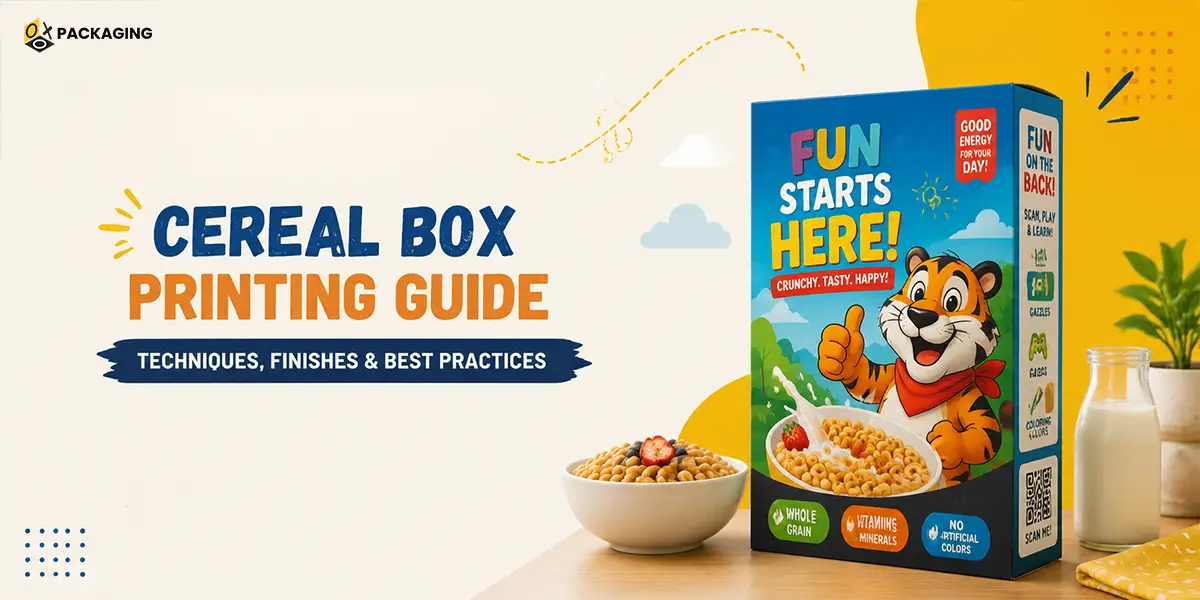
Imagine a new toy store opens next to a local grocery shop. The toy store owner wants to sell tiny puzzle boxes, but they cost too much to make. So they print colorful games right on the back of cereal boxes sold at the grocery shop next door.
In turn, the cereal maker sells more cereal because families want the fun games on the back. And the toy store gets free advertising on thousands of breakfast boxes all over town. While the grocery shop draws more shoppers who come to buy both breakfast and toys.
Put simply, everyone makes more money because a simple cereal box turns into a shared map for business growth because of crisp printing. This is the power of printed cereal boxes, so let’s dive into a detailed cereal box printing guide to help you get a competitive edge in the market:
Why Custom Printed Cereal Boxes Matter?
You have gained a basic idea of how printed cereal packaging turns a simple breakfast aisle into a high-stakes theater of your brand's survival. To get further clarity on the benefits of cereal box printing, look below:
- Create Significant Visual Impact: Bright colors and sharp graphics on cereal boxes grab buyers' attention fast on crowded store shelves.
- Build Brand Trust: High-quality printing shows customers the product inside is fresh and safe.
- Drive Customer Engagement: Smart packaging adds games, stories, and digital codes to boost loyalty.
Choose the Right Materials for Suitable Printing
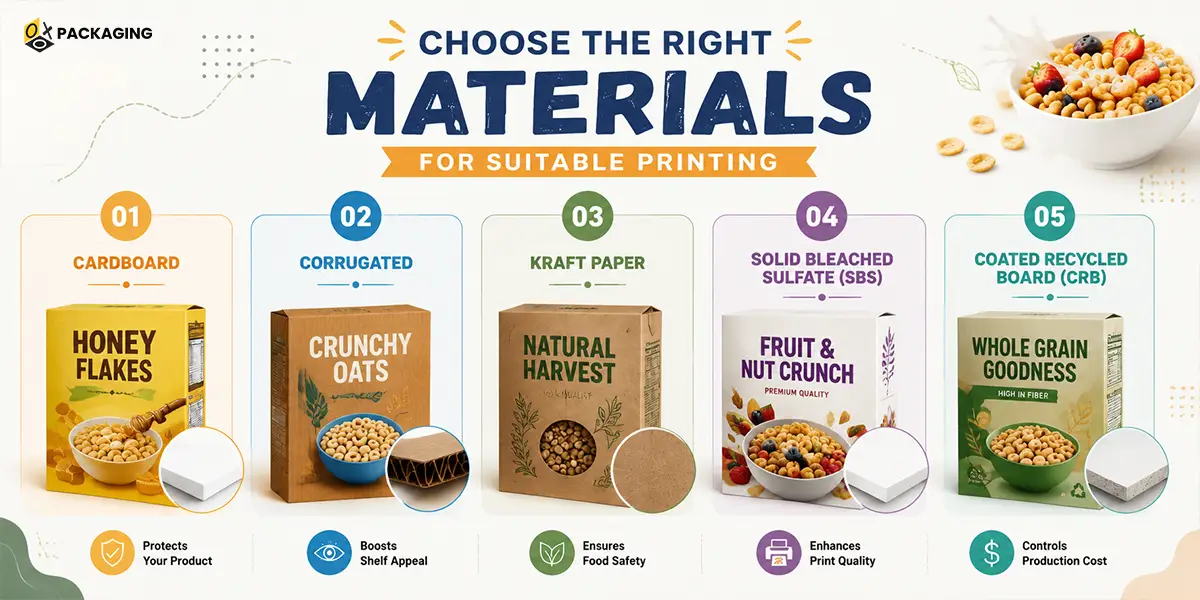
When it comes to printing cereal boxes, choosing the right materials matters due to product protection, shelf appeal, and food safety. Here are cereal box packaging materials carrying different levels of suitability for printing:
1. Cardboard
Paperboard and cardboard cereal boxes are exceptionally well-suited for printing. They feature a smooth, flat surface that readily absorbs colored inks, allowing vibrant brand logos, graphics, and nutrition facts to stand out clearly.
2. Corrugated
Standard retail cereal boxes are not made of corrugated cardboard. They use smooth paperboard, which is ideal for high-resolution printing. You can print corrugated material using flexography, but its rough, fluted texture produces lower-quality graphics than smooth paperboard.
3. Kraft Paper
Kraft cereal boxes are suitable for printing, but their porous, unbleached brown surface absorbs ink differently than glossy white paperboard, making dark inks and minimalist designs look sharp while light colors can appear muted.
4. Solid Bleached Sulfate (SBS)
Solid Bleached Sulfate (SBS) paperboard features a smooth, bright white surface, often clay-coated, that delivers crisp, vibrant graphics, sharp text, and high-end visual appeal for premium cereal and food packaging.
5. Coated Recycled Board (CRB)
Coated Recycled Board (CRB) is completely suitable and widely used for printing cereal boxes. Its clay coating creates a smooth, white outer surface that holds ink well and allows for vibrant, colorful graphics, while keeping production costs low.
Explore Cereal Box Printing Techniques
Let’s find out the main premium techniques for cereal box printing dieline that translate your brand story persuasively and flawlessly:
1. Offset Printing for Cereal Boxes
The offset printing technique is also known as “Offset Lithography.” It serves as a gold standard for retail cereal boxes. This printing technique transfers inked images from plates to rubber blankets, then to paperboard for high-resolution photo quality.
Offset printing uses oil and water to separate inked and clean areas, delivering crisp, exact images and vibrant colors for mass-produced food packaging. Also, it can use food safe packaging inks, but it requires specialized low-migration or designated food-contact formulations rather than standard commercial inks.
Benefits for Cereal Boxes
Benefits of choosing the offset technique for your cereal box printing include:
- Low Cost at Scale: The price per box drops a lot when printing huge numbers.
- Vibrant Brand Colors: Matches exact brand shades using CMYK or custom spot colors.
- Sharp Detail: Makes cartoon characters, photos, and nutrition facts very clear on paperboard.
2. Digital Printing Cereal Boxes
Digital printing for cereal boxes sends computer design files directly to a high-speed printer. This method skips physical plates, allowing fast setups, vibrant full-color graphics, and easy customization for small or test batches.
Benefits for Cereal Boxes
Benefits of choosing the digital technique for your cereal box printing include:
- No Plate Costs: Saves money on setup since physical printing plates are unnecessary.
- Fast Turnaround: Speeds up production for tight deadlines or market tests.
- Easy Customization: Lets you change designs, languages, or promotional codes on individual boxes.
- Low Minimum Orders: Ideal for small brands or limited-edition cereal runs without bulk waste.
3. Flexographic Printing Packaging
Flexographic printing is a high-speed, rotary relief method that uses flexible photopolymer plates to press vibrant images onto packaging materials like cereal box paperboard by acting like an advanced, continuous industrial stamp.
Benefits for Cereal Boxes
Benefits of choosing the flexographic technique for your cereal box printing include:
- High-Volume Speed: Runs fast and efficiently cuts down per-unit costs for millions of mass-market boxes.
- Substrate-Friendly: Easily prints on thick, absorbent, or textured paperboard used to protect food.
- Food-Safe Inks: Uses quick-drying, safe water-based or UV-curable inks that prevent smearing during high-speed stacking and cutting.
4. CMYK vs Pantone Packaging Printing
CMYK uses four inks (Cyan, Magenta, Yellow, Key/Black) blended via tiny dots to create full-color photographic images and gradients on cereal boxes. Conversely, Pantone (PMS) uses pre-mixed, custom-formulated spot inks for exact, uniform color matching, which is ideal for distinct brand logos.
Benefits for Cereal Boxes
CMYK ensures high-resolution product photography e.g., a splash of milk hitting cereal flakes), complex character illustrations, and subtle color gradients. However, PMS provides solid, flat brand elements, iconic mascot colors, or exact background hues that must look identical worldwide.
Pick Game-Changing Cereal Box Finishes
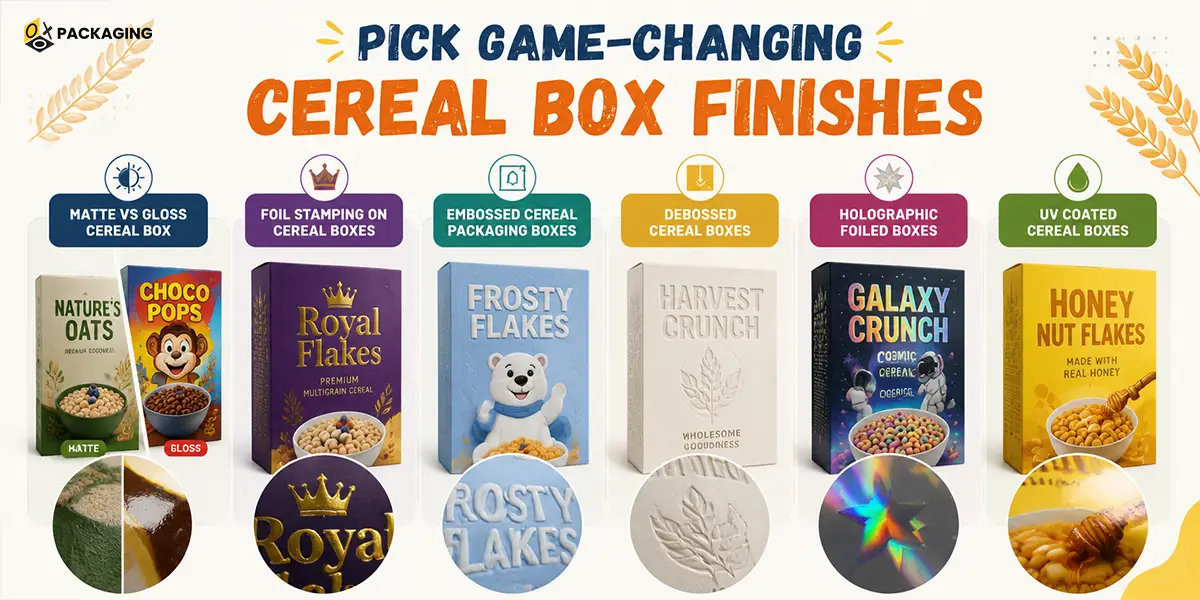
After printing your cereal boxes, you need specialty finishes to enhance colors and graphics on crowded retail shelves. The most common finishes build strong brand value to attract cereal buyers, such as:
- Matte vs Gloss Cereal Box: Choosing between a matte and gloss finish for a cereal box comes down to brand identity and shelf impact. Gloss maximizes bright color vibrancy for kids' and value brands, while matte offers a smooth, premium look best suited for organic or artisan options.
- Foil Stamping on Cereal Boxes: Make logos, character eyes, or special badges shine, helping specialty or organic cereal brands stand out on crowded grocery store shelves.
- Embossed Cereal Packaging Boxes: Engage customers through touch by adding physical depth to brand logos or character designs.
- Debossed Cereal Boxes: Add a premium, high-end feel to custom food packaging, creating shadows and depth that stand out on retail shelves alongside standard flat printing.
- Holographic Foiled Boxes: Use a reflective, multi-colored specialty finish applied to paperboard. This technique bends light to show rainbow or prismatic patterns, making the cereal packaging stand out on store shelves.
- UV Coated Cereal Boxes: Create an ultra-glossy, durable finish that protects printed graphics, resists scuffs, and makes brand logos pop on retail shelves.
Consider Best Practices While Printing Cereal Boxes
While choosing cereal box design printing, consider some important aspects to avoid flawed printed boxes, such as:
|
# |
Best Practice |
Details |
|
1 |
Choose the right material |
Use SBS board or strong cardstock for a smooth print surface |
|
2 |
Use safe inks |
Ensure all inks and coatings are food-safe and non-toxic |
|
3 |
Add moisture barriers |
Keep the cereal fresh inside the box |
|
4 |
Offset printing |
Choose for sharp, high-volume consistency |
|
5 |
Digital printing |
Use for small test batches or custom runs |
|
6 |
Vibrant CMYK colors |
Pick colors that match your brand identity |
|
7 |
Readable fonts |
Keep fonts large and easy to read on crowded store shelves |
|
8 |
Front panel branding |
Put your main logo and product name on the front panel |
|
9 |
Back panel information |
Place clear nutrition facts and ingredients on the back |
|
10 |
Side panel extras |
Use for organic claims, recipes, or additional details |
Where to Get Well-Printed Cereal Boxes?
Since you have explored everything in detail about the cereal box printing guide, choosing reliable packaging suppliers is also very important. Consider OXO Packaging for ordering wholesale printed cereal boxes due to our design expertise. We specialize in offering cutting-edge print technology and eco-friendly options like soy or water-based inks to make your cereal brand stand out on shelves.
Cereal boxes are primarily printed using offset lithography for high-resolution retail graphics on paperboard, or flexography for high-volume, cost-effective production runs. Digital printing is also used for short runs or customized packaging.
Custom cereal box printing costs generally range from $0.10 to $1.50 per unit, depending entirely on order volume, box size, and material quality.
Cereal boxes are printed using large-scale offset lithography printing on flat, coated paperboard sheets. High-resolution images, brand colors (using CMYK and spot PMS inks), and text are transferred from metal plates to rubber blankets and onto the cardboard before the sheets are die-cut, folded, and glued into final boxes.
To make a cereal box design, plan your layout with a catchy brand name, mascot, and nutrition facts on a standard die-cut template, build your graphics in a tool like Adobe Express or Canva, and print it on heavy cardstock to cut, fold, and glue.






 Let's Call