


Supplement Packaging in the U.S: How to Build Trust, Stay Compliant, and Ship Confidently
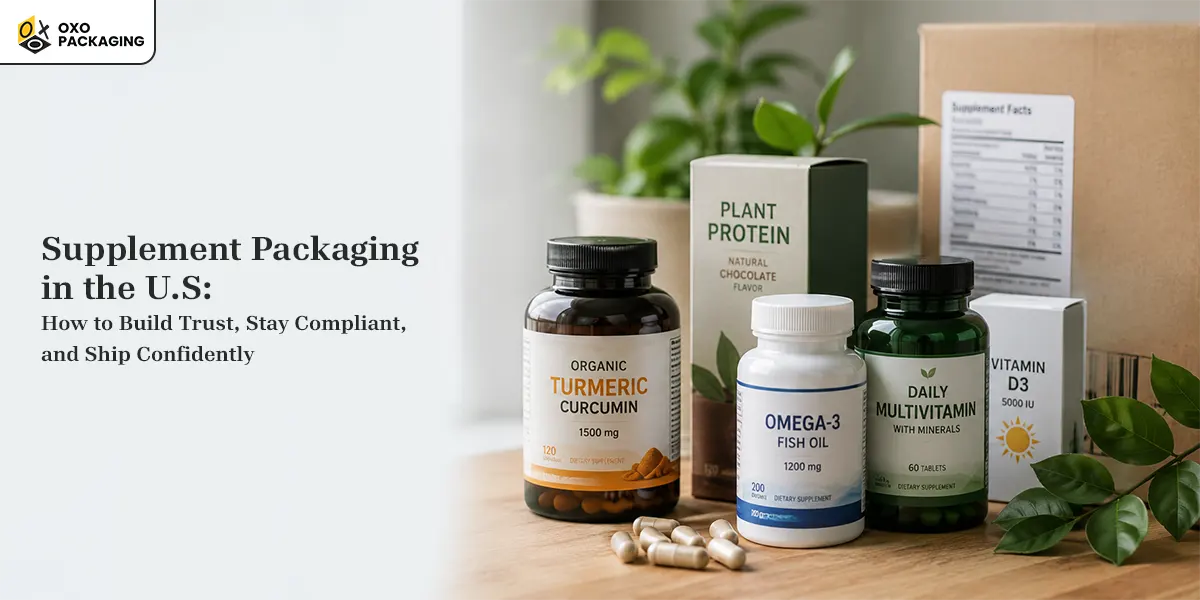
Whether you are launching wellness products or redefining your supplement packaging in the U.S., think beyond aesthetics. Because health-conscious buyers look for safe, legitimate supplements rather than only aesthetic packaging.
That’s where packaging plays a significant role. Modern buyers judge whether your supplements boxes are reliable and worth buying based on how you package your products. So your nutritional packaging must follow regulations, protect the formula, and communicate clearly.
Doing so helps your business avoid compliance issues. And build a brand that regulatory authorities and consumers both trust. Read this blog to bypass FDA regulations and attract customers by making the right packaging choices. So let's begin:
Explore 4 Main Roles of Supplement Packaging
Supplement packaging serves four primary roles, including labeling compliance and protecting product integrity. Have a look at them in detail:
Compliance and Safety (Reduce Risk)
According to the FDA's Dietary Supplement Labeling Guide, your supplement label must prominently feature a statement of identity, net quantity, "Supplement Facts" panel, ingredient list, and manufacturer information. If you fail to comply, then you may face product detention, seizures, or costly relabeling.
Trust and Credibility (Give Proof of Safety)
Whether supplement or OTC packaging, you need to arrange information so consumers can instantly find essential details such as active ingredients and safety seals. Use clear, concise language and typography with readable facts, and professional finishing for transparency to increase consumer trust in your products.
Performance (Protect Product)
Ensure your product integrity against environmental factors like moisture, light, oxygen, and pests. For this purpose, you can use sealed pouches or rigid bottles to prevent physical damage during shipping.
Differentiation (Act as Primary Marketing Tool)
Customers often decide on a product in under three seconds. A strong visual system ensures your brand is noticed and remembered, acting as an “instant choice-maker.” So use bold, clean visual merchandising techniques, such as strong color contrast and clear, consistent layouts, to cut through visual noise.
Consider Key Constraints
Since supplements operate in a highly regulated space (often treated as food or between food and pharma), the “invisible” constraints, such as regulations, stability, and logistics, dictate the physical form. Explore them in detail:
View Pre-Visual Checklist
Before developing concepts, lock these three key areas for health supplement packaging to avoid costly re-designs or product recalls:
- Formula & Stability Needs: Your chosen material must protect ingredients from moisture, oxygen, and light. It needs testing to choose between rigid plastic, glass, or high-barrier pouches.
- Legal & Regulatory Compliance: Special warnings are needed for specific ingredients, such as iron, major allergens (the "Big 9"), and high-dose vitamins. Also, strict labeling, ingredient lists (in descending order), and proper dosage are non-negotiable.
- Structure & Functionality: Defining the size based on your product volume and ensuring it fits on retail shelves. Incorporate child-resistant and tamper-evident closures to ensure safety measures are in place for consumer confidence and regulatory compliance.
Translate Constraints into Design Strategy
Once the constraints are established, they guide your visual design for your vitamins packaging, not restrict it.
- Information Hierarchy: The regulatory and mandatory text (Supplement Facts, warnings) often takes up significant, fixed space, influencing the placement of brand elements.
- Sustainability as a Design Feature: Rather than an afterthought, designing for recyclability, e.g., using monomaterials, can become a visual and marketing asset.
- Dieline Definition: You must establisha precise dieline, the flat layout of the packaging, incorporating bleed, safety margins, and structural elements like closures.
- Cohesion Across SKUs: If your brand has multiple products, creating a consistent visual identity that applies to different bottle sizes or pouch shapes is essential.
Finalize Visuals After Compliance
Once you finalize your constraints, your design should focus on the following factors:
- Shelf Impact: Ensuring your design stands out from 3 feet away.
- Brand Identity: Incorporate your brand-specific colors, typography, and graphics that communicate quality and attract your target audience.
- Cleanliness: Avoid cluttered packaging by balancing essential information with appealing, clear graphics (except medical-looking graphics that imply disease treatment).
Check Mandatory On-Pack Information
The FDA, under the Dietary Supplement Health and Education Act of 1994 (DSHEA) and 21 CFR Part 101, strictly regulates supplement packaging. As of 2026, it necessitates:
Must-Have Elements on Label
Your label must contain five key elements, typically on the principal display panel (front) or the information panel (right of the front):
Statement of Identity: The name of the product, which must include the term “dietary supplement” or a description such as “herbal supplement” or “vitamin C capsules”
Net Quantity of Contents: The numerical count (e.g., “60 Capsules”), weight, or volume of the product.
Supplement Facts Panel: You must place the following in a box
- The recommended daily serving
- A list of nutrients or substances, including their amount per serving and percentage of Daily Value (%DV)
- Total weight of the blend with component ingredients listed in descending order of predominance
Ingredient List (Other Ingredients): All inactive ingredients (e.g., gelatin, starch, colors) must be listed in descending order of predominance, and must be listed separately from the Supplement Facts panel.
Name and Place of Business: The manufacturer, packer, or distributor's name and address.
Directions for Use: Clear instructions on how to use the product.
Other Required Elements: You must include allergen warnings and a disclaimer. For example, major allergens ("Big 9") must be clearly declared.
Avoid Common Labeling Failures
Look at some failures that, in case of negligence, often lead to FDA warning letters, import detentions, or recalls:
- Illegal Disease Claims: The most common high-risk error is using language that implies a product treats, cures, or prevents disease, like “cures arthritis” instead of “supports joint health.”
- Incorrect Supplement Facts Format: Missing the required font sizes, hairline box formatting, or failing to use the correct 2026 Daily Values.
- Misleading Marketing: Using “clinically proven” or “natural” without scientific substantiation.
- Incomplete Ingredient Listing: Missing “other ingredients” or failing to list all components of a proprietary blend.
- Missing or Incorrect Allergens: Failure to declare major allergens properly.
- Missing U.S. Responsible Party: Not listing a domestic address or phone number for adverse event reporting.
Prevent Design and Physical Packaging Mistakes
If you fail to account for cardboard thickness, it can result in boxes that won't close or protect the product. Also, avoid making the mistakes given below:
- Ignoring Material Thickness: Failing to justify the thickness of materials like 350gsm paperboard leads to boxes that bulge or won't close.
- Inadequate Bleed and Safe Zones: Compliance text placed too close to the edge may be cut off during the die-cutting process, making it legally non-compliant.
- Poor Barrier Protection: Using packaging that does not protect against humidity and light, allowing ingredients to degrade before their expiration date.
- Incorrect Hierarchy of Information: Crowding mandatory text with marketing elements, making it illegible.
Fix Top 3 Supplement Packaging Compliance Mistakes
Here are the top 3 supplement packaging compliance mistakes to avoid:
Avoid Missing "Supplement Facts" Panel
If you use improper font sizes, line styles, or omit required elements in the nutrition panel, it causes regulatory noncompliance. To avoid it, follow FDA guidelines precisely while using a professional designer familiar with supplement regulations to ensure the "Supplement Facts" panel meets all formatting rules.
Escape Incorrect Specific Ingredient Warnings
The FDA may ask you for product recalls if you don’t include mandatory safety warnings, such as for iron-containing products or choking hazards. So, verify formula requirements early in the design process to ensure mandatory warning language and appropriate child-resistant packaging are included.
Improper Net Quantity Statement or Incorrect Units
Many packaging manufacturers lack a clear net quantity statement or use wrong measurements. Like they usually mix metric vs. US customary units on the front panel. However, you must display net quantity clearly on the front panel in both metric (grams/ml) and U.S. customary units (ounces/fl oz).
Consider Core Protective Materials & Structures
It doesn’t matter how beautifully your vitamins, supplements, or other wellness products look if your packaging fails to protect their potency. So ensure you align your packaging with the following options:
Adhere to Regulatory Demands
Under FDA cGMP regulations (21 CFR Part 111), dietary supplement manufacturers must ensure that the finished product meets all specifications, including nutrient content, through the end of its labeled shelf life.
The regulation mandates that your product contain 100% of the labeled amount of ingredients. And if your formula fails to degrade before the expiration date due to packaging choices, the FDA can render your product legally “misbranded” or “adulterated”.
Comply Material and Structure
Based on the requirements for light, moisture, oxygen, and individualized packaging, here are the recommended strategies to maintain potency and prevent degradation:
Light Sensitive Materials
- Amber Bottles: Use amber glass for liquids to block UV light and protect against photodegradation.
- Opaque Containers: Utilize opaque, high-density polyethylene (HDPE) bottles for solid formulations.
- Blister Packs: Employ PVDC or aluminum-aluminum (Alu-Alu) blisters, which provide high-barrier protection.
Moisture Sensitive Powders
- High-Barrier Closures: Implement foil induction seals to prevent moisture vapor transmission, especially for hygroscopic materials.
- Desiccant Strategy: Include canisters or pouches containing silica gel or molecular sieve desiccants to absorb trapped moisture.
- Packaging Type: Utilize cold-form aluminum (Alu-Alu) blisters for maximum moisture protection.
Oxygen Sensitive (Oils)
- Barrier Properties: Utilize aluminum tubes or special high-barrier plastic bottles that prevent oxygen permeation.
- Headspace Management: Use nitrogen flushing to replace oxygen in the headspace before sealing.
- Seal Integrity: Use air-tight closures to prevent oxidation that leads to rancidity or degradation of active ingredients.
Subscription/Personalized Packs
- Medical-Grade Barrier Films: Use materials such as Aclar® or PVDC-coated films to maintain stability for individual doses.
- Nitrogen Flushing: Apply nitrogen during the pouch-filling process to remove oxygen and prolong stability.
Pick Tamper-Evident Feature
While not always legally mandated for every supplement scenario, visible safety cues, such as shrink bands, induction seals, and tear strips, act as a crucial, non-optional component of user experience (UX) that signals brand quality and safety.
Incorporate Child-Resistant Packaging
Compliance with the Poison Prevention Packaging Act (PPPA) is a mandatory safety requirement for iron-containing supplements and medications. Recent 2026 recalls highlight the severe consequences of non-compliance, including potential death from iron poisoning.
You must opt for Child-Resistant Packaging (CRP) if your non-injectable iron-containing dietary supplements or drugs contain a total amount of 250 mg or more of elemental iron per single package.
Navigate Packaging Channels
Whether you are choosing online or offline channels for delivering supplements, you need to consider the following factors:
Online
Amazon is a logistics machine. Before aesthetics, your packaging must be designed for efficiency to avoid costly returns. Your barcodes must be placed on flat surfaces to ensure readability without distortion.
Strict adherence to poly-bagging rules and mandatory suffocation warnings (including specific font size thresholds) is required. So your supplement packaging must be designed to survive the distribution chain without leaking or bursting.
Offline
When it comes to selling your supplement or vitamin packaging, you are fighting for attention in a physical store. Your design needs to shift from “logistics-first” to “psychology-first.” For this purpose, reduce cognitive load through color-coding and iconography.
Or leverage distinct color systems or body-part icons to help shoppers instantly identify your supplement’s benefit without needing to read the fine print.
"Clinical" to "Counter-Worthy"
Move away from the sterile, cold look of traditional medicine. Modern supplements embrace lifestyle aesthetics, using typography, texture, and color to create an emotional connection. Design a package so well-designed that your customers leave it out on their kitchen counter, rather than hiding it in a medicine cabinet.
Explore the Most Popular Supplement Packaging Trends in the US
Sustainability, on-the-go convenience, and minimalist designs drive the supplement packaging landscape in the U.S. Have a look at the most popular trends below:
Extending Beyond Basic Sustainability
Rather than just using generic recycled material, forward-thinking brands are striving for higher closed-loop percentages (e.g., 80% to 100% PCR content) to actively divert plastic from landfills. Replacing petroleum-based inks with bio-based inks, such as soy, minimizes Volatile Organic Compounds (VOCs) and makes paper components far easier to compost or recycle without toxic chemical leaching.
Promoting Reusability and Refill Concept
By relying on home-compostable, bio-based pouches or paper packs for monthly replenishments, companies significantly cut down on single-use plastics. Fewer bulky plastic or glass bottles being produced means a notably lower carbon footprint throughout the global supply chain.
Shifting Towards Modern Branding Aesthetics
Modern supplement packaging is transitioning from a clinical, pharmacy-led style into a lifestyle aesthetic. It focuses on intuitive visual navigation, sustainability, and premium unboxing experiences.
For example, labels are shifting away from heavy blocks of text in favor of minimalist typography and organized data that communicate benefits immediately. Also, tactile finishes such as soft-touch matte coatings, embossed or debossed typography, and matte-metallic combinations are becoming mainstream.
Consider Popular Examples for Supplement Packaging
The following 3 packaging examples illustrate exactly what “good” looks like across different supplement categories and design philosophies:
Pendulum
To eliminate plastic waste, Pendulum ships its supplements in industrial compostable refills rather than disposable plastic bottles. Their centerpiece is a custom-molded, petri-dish-inspired container.
Finished with a premium soft-touch coating, it serves as a sleek, permanent countertop display rather than something meant to be tossed in the trash. This perfectly complements their subscription model, ensuring users only ever need to replace the contents, not the container.
Aava
The brand successfully bridges its natural Nordic heritage with scientific precision through intentional material choices and a clean, Scandinavian aesthetic. They use highly recyclable, food-grade transparent plastic for their supplement containers.
This choice was deliberate, allowing consumers to see the product while retaining the highest post-recycling value and minimizing waste.
AgeMate
AgeMate strategically shifts from traditional pill bottles to a premium, minimalist powder container. Designed to look modern and approachable rather than medical, it directly influences consumer habits, improves compliance, and perfectly reflects the brand's premium longevity and wellness positioning.
Where to Find Compliant Supplement Packaging?
Finding a reliable packaging supplier for compliant supplements packaging is extremely important. OXO Packaging is one of the credible suppliers that specializes in packaging that meets strict international regulations.
A "vitamin pouch dip" refers to small, porous pouches, similar in shape to tea bags, packed with vitamins, herbs, and natural energy boosters.
Vitamin pouches are typically made using multi-layer flexible films to protect the contents from moisture, oxygen, and light. These materials are generally heat-sealed and FDA-compliant for safe food contact.
Top supplement packaging companies include OXO Packaging, Custom Boxes Lane, and The Customize Boxes. They offer custom retail boxes, mylar bags, and jars with full-color printing and free design services.
Top biodegradable supplement packaging options include Polylactic Acid (PLA) bioplastics, compostable Kraft paper pouches, and natural mycelium or bagasse containers.







 Let's Call